
By Monica E. Oss, Chief Executive Officer, OPEN MINDS
About 1% of emergency department (ED) visits in the U.S. are related to mental health or substance use disorders (SUDs). For every 1,000 ED visits, 53 of them are related to mental health per data from the new analysis, Mental Health-Related ED Visits.
For SUDs, 49 out of every 1,000 ED visits were drug-related. These data are based on primary diagnoses and do not include behavioral health conditions as a secondary reason for ED visits.
Of the mental health disorders driving ED use, 47.4% were for anxiety and 37.5% were from depression and bipolar disorder. The remaining 7.7% and 7.4% were for trauma/stress and schizophrenia, respectively.
The use of EDs also drives behavioral health inpatient utilization. Almost two-thirds (66%) of inpatient mental health admissions and 32% of inpatient SUD admissions started with an ED visit.
The authors of the first analysis noted, “Mental health-related ED visit rates show the importance of providing adequate emergency services for those in crisis. They also highlight the need for sufficient mental health services in non-emergency (outpatient) settings that can help prevent crises before they start.”
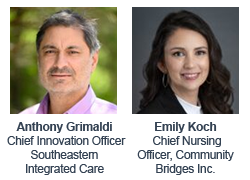
Developing non-hospital alternatives to crisis stabilization was the focus of a recent session, Breaking Into The Crisis Market: Case Studies On Successful Expansions For Crisis Organizations, at the 2026 OPEN MINDS Strategy & Innovation Institute. Emily Koch, Chief Nursing Officer of Community Bridges Inc. (CBI), and Anthony Grimaldi, Chief Innovation Officer of Southeastern Integrated Care, shared how their organizations were creating and sustaining new crisis service models.
Founded in 1982 in Mesa, Arizona, CBI has 1,800 employees providing multiple lines of care in Oklahoma, Washington D.C., Idaho, New Mexico, and Oregon. Between crisis mobile teams, residential and bridge housing facilities, and substance abuse services, CBI provides care to those with serious mental illness, SUDs, and intellectual or developmental disabilities (I/DD), among others.
One of CBI’s newest initiatives – Washington D.C. Stabilization Center – opened over three years ago. The center is a joint effort with the D.C. Department of Behavioral Health (DBH), first responders, and existing agencies, and is a completely new service line in the area.
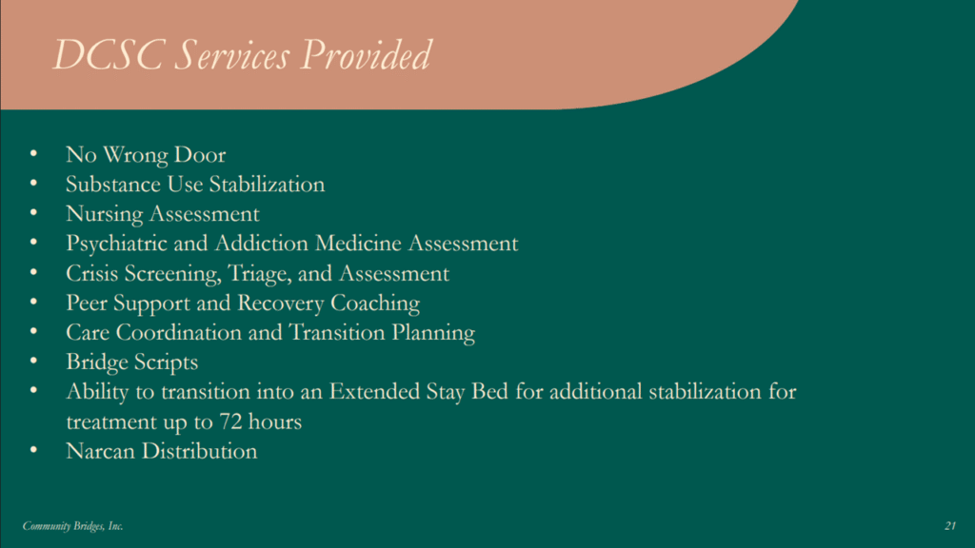
The model provided 22 sobering locations – 16 chairs for up to 24 hours’ use and six extended-stay chairs for up to 72 hours – so that local fire departments (FDs) could drop off program participants directly and avoid unnecessary ED transfers. Employing a “No Wrong Door” model, CBI also offered assessments and triage with behavioral health nurses, peer support specialists, and recovery coaches, and aims to remove barriers to ongoing care. “CBI was founded in the back rooms of Alcoholics Anonymous by members who saw people dying from alcoholism and drug addiction with nowhere to go,” explained Ms. Koch. “Our models are about providing what communities need. Where there is no bridge, we build one.”
To date, CBI’s performance data shows an average length of stay of 14 hours with a 1% rate of medical transfers. There have been 17,900 admissions, including 5,974 fire department drop-offs. Ms. Koch explained, “We’ve created a program specific to our top 20 highest utilizers who are actively case-managed to break the crisis cycle. This is our ‘secret sauce’ to freeing up capacity in the system – getting individuals into treatment long-term and decreasing crisis utilization.”
SEIC, based in Pembroke, North Carolina, grew from a single site in 2017 in one of its most rural areas – 950-square-mile Robeson County – to now cover five counties with 17 sites, treating thousands of consumers through integrated behavioral health, I/DD, SUD, and primary care services.
According to Mr. Grimaldi, the local care system had a long and challenging history: EDs were overcrowded, the local hospital had only nine of 2,700 beds dedicated to behavioral health and SUD cases, and law enforcement (LE) was the default responder. The system required transformation, not incremental change. “At SEIC, we have this belief that sometimes, if it’s not broken, we need to break it and turn it upside down,” Mr. Grimaldi stated.
SEIC’s solution entailed creating an entirely different behavioral health urgent care model in which their acronym EMPATH (Emergency Psychiatric Assessment, Treatment & Healing) translates into immediate engagement, rapid stabilization, and dignified, parallel care. SEIC also co-responds with existing local teams for maximum efficiency. “We go where the clients are. We do not wait for a call. Our center is similar to CBI’s Stabilization Center, but also offers complete comprehensive medical, psychiatric, and substance abuse services.”
Mr. Grimaldi stated that SEIC merges a “No Wrong Door” policy with a pit crew mentality, offering clinical assessments, psychiatric evaluations, medication management, and more. They serve their rural communities as a National Best-Practice model, with initial revenue streams from Medicaid, state funding, grants, and partnerships. Current sustainability steps include Medicaid-enhanced rates, prospective payment systems, psychiatric evaluations, and value-based reimbursement.
Since it opened in early 2026, SEIC’s results have resulted in a 91% hospital diversion rate with a 43% reduction in LE transports to medical facilities. In the process, the program has assured that 87% of consumers are receiving full crisis assessment and intervention.
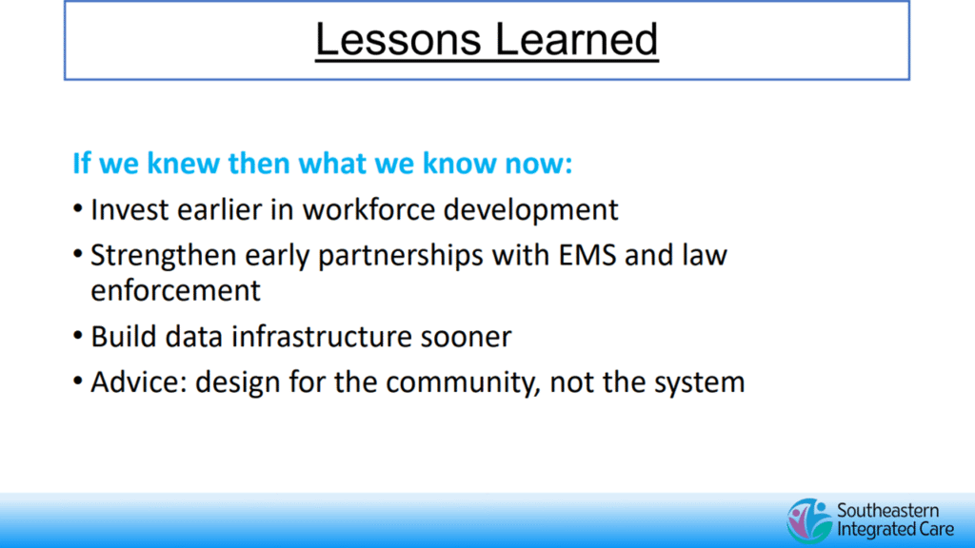
For provider organizations looking to create new models in their communities, these executives offered the following wisdom. “Your work needs to be about saying ‘yes’ and asking, ‘How can we help?’ Not, ‘This person doesn’t fit into our box,’” Ms. Koch offered. “To get it to work, we are going to change the shape of the box if we need to.” Added Mr. Grimaldi, “My advice for anyone wanting to replicate this behavioral health urgent care model is to design it for the community, not the system. We don’t believe in programs, which can be exclusive; we believe in services. We wrap services around people based on their needs.”