
By Monica E. Oss, Chief Executive Officer, OPEN MINDS
There is a lot of discussion of whole person care and integrated delivery systems. The question is what does a best practice model look like for whole person care for consumers with behavioral health conditions? According to a recent whitepaper, Delivering Mental Health Care In The Waiting List Era, the target is a stepped, hybrid digital-clinical model that continuously monitors consumer needs. At the core of this model is an adaptive care engine, supported by embedded clinical governance and risk escalation, which adjusts services based on symptom progression, engagement, and risk signals. It also requires a continuous contact strategy with ‘care’ happening not just during ‘appointments’ but on an ongoing basis with evidence-based digital tools for self-management, tech-enabled therapy, and ongoing monitoring.
To make this ‘vision’ a reality, the authors outline key tech functionality. To drive awareness and self-guided consumer response: online screening and educational resources, self-guided programs, and evidence-based digital interventions like cognitive behavioral therapy modules, psychoeducation, self-management, guided digital care to track symptoms and outcomes, and personalized feedback from an online coach. When clinician involvement is needed, clinician-led teletherapy and virtual visits, facilitated treatment planning, and measurement-based care. And when acute care needs requires high-risk escalation, the ability to move consumers toward urgent in-person intervention, crisis hotlines, and acute care services, as necessary.
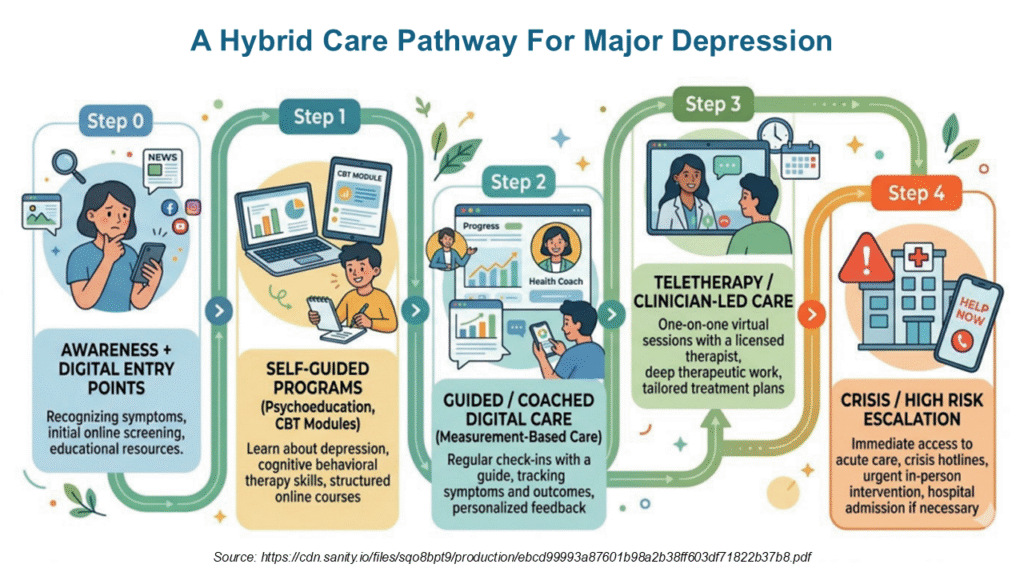
This hybrid stepped care model matches the intensity of support to the needs of the individual while coordinating all the players in the ecosystem. Consumers have a choice – to engage digitally, remotely, or in-person. Care starts before appointments even begin, and continues in-between and during visits. So what used to be a period of silent decline now has become an active phase of care.