
By Monica E. Oss, Chief Executive Officer, OPEN MINDS
Residential treatment for children appears to be a bit of a black box. The recent report – Addressing Appropriate Access To Residential Behavioral Health Treatment For Children In Medicaid – identified both lack of definition and lack of data as challenges to policy.
In fiscal year 2026, the U.S. had 376 psychiatric residential treatment facilities in 36 states, while 14 states had none. There is little data on the use of that capacity.
A 2018 analysis found that roughly 4% of children age 0 to 18 had a claim for residential services. A 2019 claims analysis found that less than 0.1% of children ages 3 to 17 who were enrolled in Medicaid used residential behavioral health treatment services.
And out-of-state placement for residential services appears to be on the rise. In Montana, out-of-state placement rose 14% from 2023 to 2024. In North Carolina, the share of children in psychiatric residential treatment placed outside the state rose from 27% in 2016 to 44% in 2022.
The challenge from a system planning (and market planning) perspective is that the data is spotty at best. There is no single federal data source that systematically collects data on the use of residential treatment by Medicaid-enrolled children – and federal regulations do not require states to collect this data. As a result, most state Medicaid plans don’t gather data based on the types of residential treatment facilities and their respective treatment modalities. Only 17 states have psychiatric bed-tracking systems, and only five have made the information public.
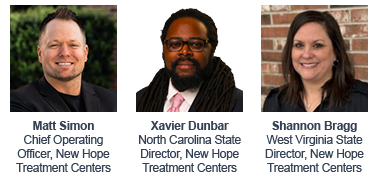
In the midst of growing need for treatment for children with behavioral and cognitive disorders, how best to use residential levels of care remains a challenge for payer and provider organization executives alike. We got to learn how an executive team approached that challenge in the OPEN MINDS Executive Roundtable, Transforming Adolescent Residential Services: The New Hope Case Study. Matt Simon, Chief Operating Officer; Xavier Dunbar, North Carolina State Director; and Shannon Bragg, West Virginia State Director, of New Hope Treatment Centers presented two residential program designs and how they help youth transition from treatment to the community.
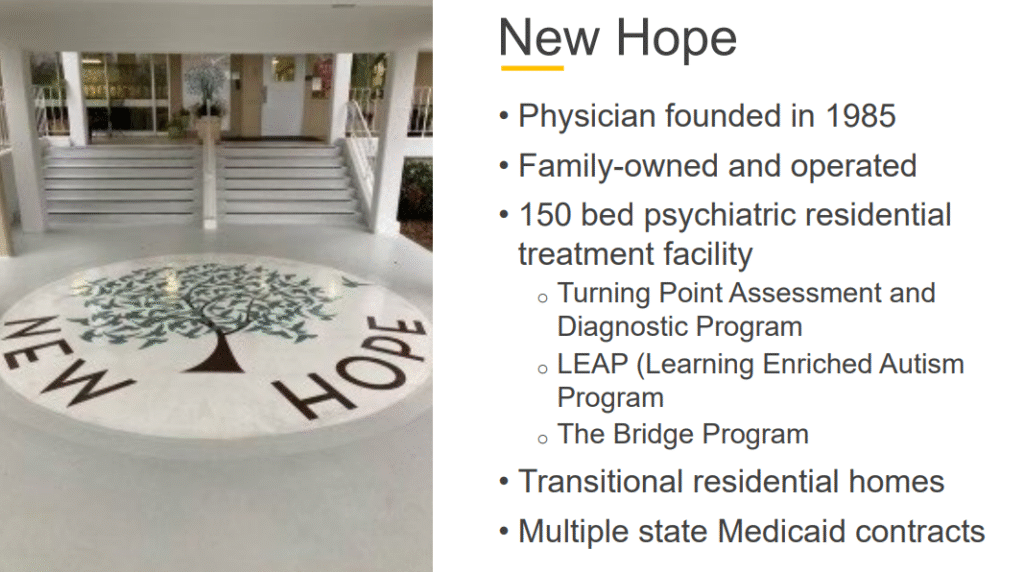
New Hope is a physician-founded, residential treatment provider organization, operating with multiple state Medicaid contracts and serving youth ages 12 to 21 with a variety of behavioral and mental health challenges. Headquartered in North Charleston, South Carolina, New Hope serves an estimated 400 youth annually and employs an estimated 550 employees across three locations, including North Carolina, South Carolina, and West Virginia.
New Hope’s push to improve its residential services arose after a market scan that found that 90% of states reported shortages of inpatient or residential beds for adolescents and 94% reported reduced access since 2020. At the same time, these adolescents presented with greater aggression, violence, self-harm, clinical acuity, staff assaults, and safety concerns.
In response, New Hope built the Bridge Program as an extension of its 150-bed psychiatric residential treatment facility. In the Bridge Program, which is a non-reimbursable program, a full-time employee works with the participating youth’s parent/guardian in their home weekly while the youth is in residential care. The purpose is to prepare the family for reunification and coordinate the transition to community services. The program extends for 90 days after discharge.
In addition, the New Hope team built six-bed transition homes – now in Milton, West Virginia and more in development outside of Nashville, Tennessee. The transition homes offer intensive therapy, family participation, recreation, individualized assessments, high staff ratios, and home-like surroundings. The model is for high-acuity youth who require residential treatment, but may not require large, locked institutional settings – or have been denied by other in-state programs.
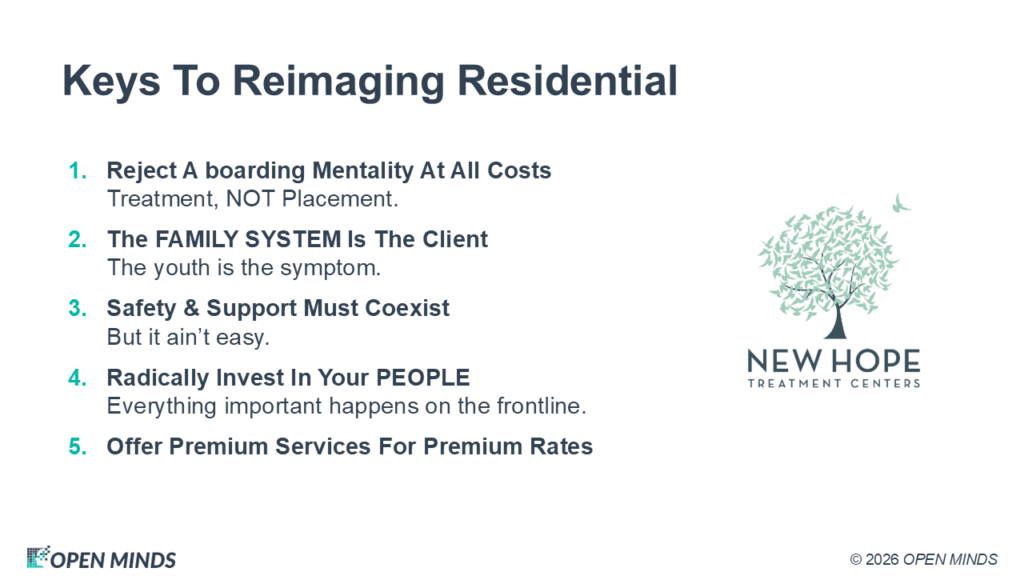
The executives offered two pieces of advice to their peers who are interested in developing residential treatment options. First, never treat residential care as housing. And make the entire family the center of the treatment model.
The New Hope team emphasized that executives should reject the “boarding mentality” in both thought and model design. This happens by building the model on four key elements – starting discharge planning at intake, identifying strengths and available community supports, setting a target transition date, and providing the intensity of service required to achieve the treatment objectives.
“We’re not meant to house kids,” said Ms. Bragg. “We do provide treatment, but we’re not a boarding facility. It’s our duty to provide services that allow our kids to move to a lower level of care, a foster home, or back to their own homes. For us to accomplish that, we provide the intensive therapeutic services, but we start discharge planning in the beginning, and we involve the treatment team, the family, and the youth. We look at what their strengths are. We want to know what their plan will be when they leave our care.”
The other key design element in creating innovative resident care is making “family work” a core tenet of the program. This means assigning dedicated staff to guardians, involving those guardians in treatment decisions and home preparation for reunification, and providing continued support through the transition to community care – even if some of these services must be provided outside of traditional billing structures.
“Residential treatment, regardless of the level of care, needs to view the consumer as the family system,” said Mr. Simon. “In most settings, the regulations in residential basically require maybe one family therapy session a month, so improving that is not going to be by regulation. It’s going to be provider organizations stepping up to do what’s best and lean in. I promise you, this approach is going to get better outcomes, reduce length of stay, and reduce recidivism.”
For behavioral health provider organizations, the opportunity is to compete based on clinical excellence. As Mr. Simon emphasized, this means demonstrating stronger transitions, lower recidivism, shorter lengths of stay, and better long-term outcomes. “If you’re going to lean into this challenge, you do have the opportunity to get premium rates, and your financials can be strong, but you have to offer premium services.”