
By Monica E. Oss, Chief Executive Officer, OPEN MINDS
Agile is out. Projects are in.
That was the message of an article, The Project-Driven Organization, that caught my attention. The premise—Agile can no longer keep up with the chaotic market and evolving technology.
Many health and human service organizations are using Agile frameworks—frameworks they were never designed to address. The reason? The entire field is being redefined. Advanced analytics are compressing decision cycles—and consumers (and their health plans) expect personalized, real-time experiences.
In this new market landscape, moving to the project-driven organization is the next logical evolution—a new enterprise model that places projects at the center of how organizations are structured, led, and generate value. Instead of simply optimizing teams or workflows, it redesigns everything around dynamic, empowered, cross-functional teams.
But traditional project management needs an “upgrade” for project-driven transformation to succeed. Projects need to be at the center of the organization’s strategy for value generation—and executive teams have to rethink organizational design and leadership for that to happen.
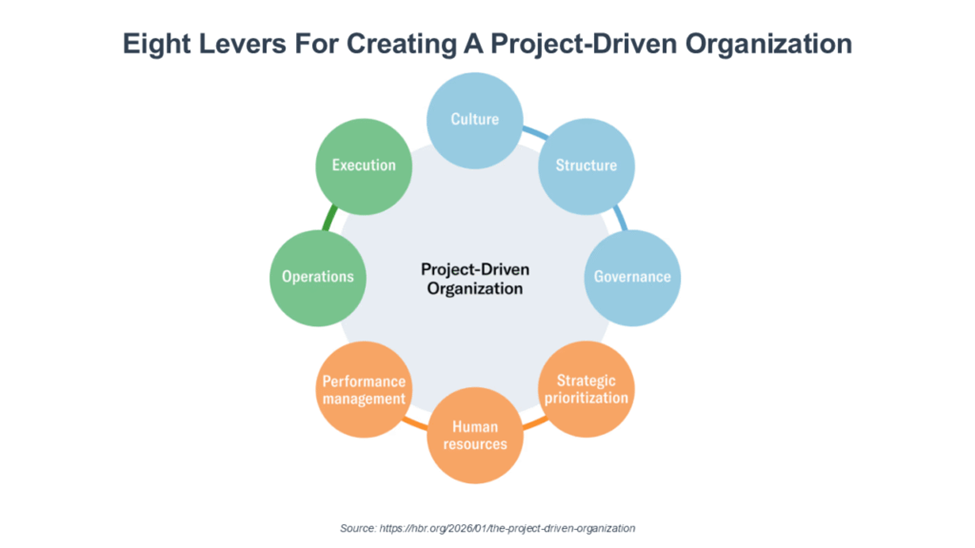
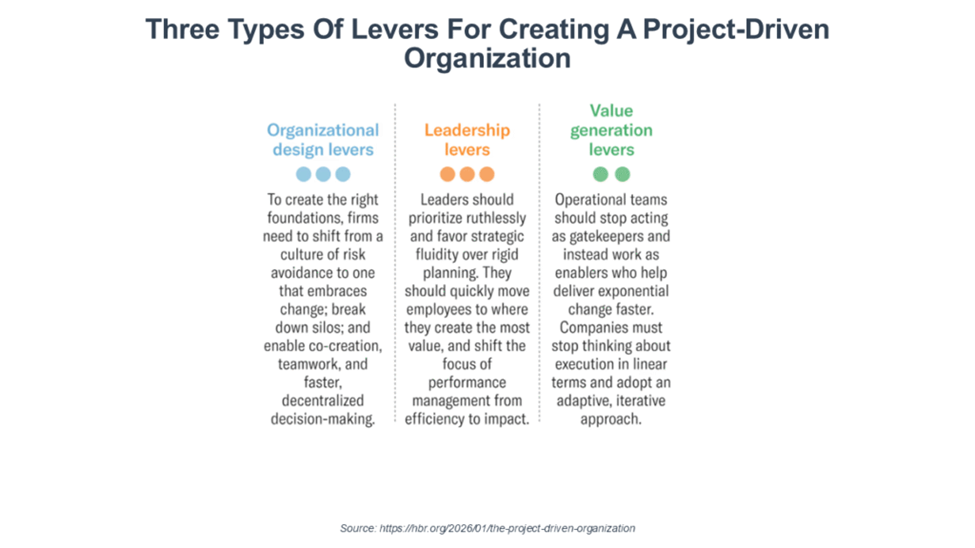
To do this, executive teams need to use eight key levers. The first three—changing culture, changing structure, and changing governance—concern organizational design. The second three—changing the approaches used to set strategic priorities, deploy human resources, and manage performance—concern leadership. And the final two—changing operations and changing execution to facilitate fast, high-impact delivery—concern value generation.
The question is whether this concept of project-driven transformation can work in health and human services—and, if so, how. To answer that question, I asked a few of my colleagues for their insights.
OPEN MINDS Senior Advisor Deanne Cornette advised that the model can work in health care, but it needs to be applied thoughtfully. Health care organizations already run on projects, such as electronic health record implementation and value-based care pilots with payers. But these projects are overseen by managers on top of their day-to-day operational responsibilities.
“In this model, project-driven transformation models need to be the primary role of appointed key staff. A project-driven model makes that explicit,” Ms. Cornette said. “It helps organizations move faster on priorities that matter most, especially in an environment defined by workforce shortages, regulatory change, payment reform, and rising expectations for whole-person care. The key is balancing disciplined project execution with the clinical stability and reliability patients depend on.”
OPEN MINDS Senior Advisor Sharon Hicks took a more cautious approach. One of the biggest challenges is that most health and human services demand a certain amount of flexibility by consumers and by payers.
“Human beings and their families are so varied, it is almost impossible to consider every scenario in determining the initial scope of a project,” Ms. Hicks said. “This inevitably leads to scope creep, which is a common reason why most projects fail.”
Her advice to organizations moving forward with the project-driven transformation model is to make sure that every project has well-defined expectations and outcomes, accurate initial estimates of time required and other resources, and support for process change.
OPEN MINDS Senior Advisor Margaret Mays, Ph.D., noted that some health plans are already using project-driven transformation—particularly in technology, clinical operations, Healthcare Effectiveness Data and Information Set reporting, and customer service. Provider organizations have been slower to implement the approach.
For provider organization executive teams looking to take the next step beyond Agile, she suggests starting with an assessment. This would include organizational structure, the governance model, strategic planning process, performance management tools, decisionmaking model, process standardization, and communication infrastructure, among other factors. “Each of the eight levers should be in place and operational to guarantee the success of the new model,” Dr. Mays said.
Ms. Cornette echoed that advice. “After the initial readiness assessment, leadership teams should start small by testing the model on a few high-impact initiatives. This will allow them to build confidence and create momentum before scaling across the enterprise—and prepare for continued change in the year ahead.”