
By Monica E. Oss, Chief Executive Officer, OPEN MINDS
Earlier this month, the Centers for Medicare & Medicaid Services (CMS) released its ‘state toolkit’ on applied behavior analysis (ABA) benefit management. The toolkit was released with the purpose of supporting “state Medicaid and Children’s Health Insurance Program (CHIP) agencies in making decisions regarding ABA service provision for Medicaid and CHIP beneficiaries with autism spectrum disorder (ASD).”
The toolkit provides recommendations on the autism diagnostic process, treatment planning, medical necessity, prior authorization, and Medicaid managed care. Interestingly, the toolkit also advises against any ‘cookie-cutter’ approaches to treatment, emphasizing that comprehensive autism assessments may require 20 hours or more to complete initial evaluations. It does stress the importance of ‘individualized treatment plans’ for ABA services to ensure that the plans do not exhibit a “copy-and-paste approach”. And it states there are no metrics established for what is considered a low- or high-level intensity intervention, nor consensus on the number of hours recommended for treatment. However, in the authors’ words, “intervention intensity and frequency are not correlated with improvement in outcomes, in that high levels do not equate to better outcomes compared to lower levels.”
As a disclaimer, the toolkit authors state that the toolkit is “not a regulation.” It “should not be interpreted as establishing a standard of care or directing clinical judgment” and “does not endorse or require any particular treatment modality.” The question is whether, and how, the recommendations in the toolkit will be put to use by payers.
In last month’s OPEN MINDS executive webinar, Beyond FFS In ABA – Alternative Reimbursement Models To Improve Autism Treatment Quality & Reduce Costs, my colleague and OPEN MINDS Vice President of Clinical Excellence & Leadership, Stuart Buttlaire, Ph.D., discussed using alternative reimbursement models as a way of improving flexibility, outcomes, and cost of ABA treatment. I asked him to share his thoughts on this CMS document.
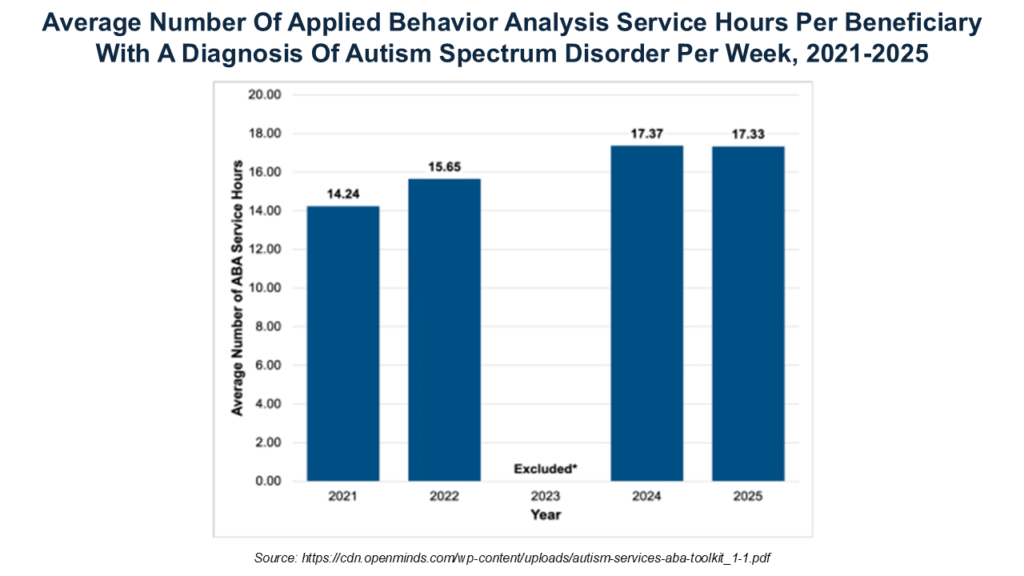
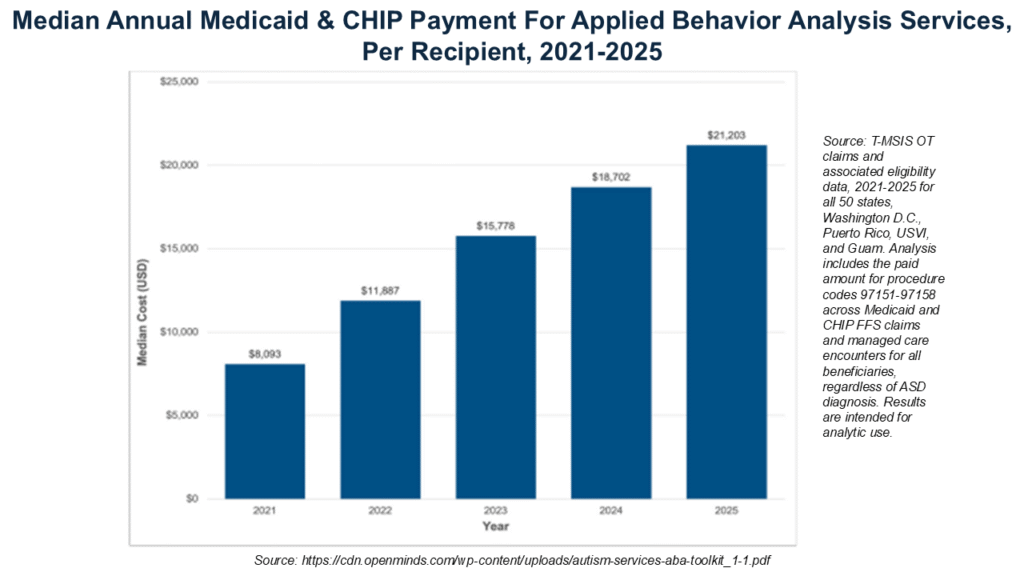
In his words, there’s no doubt CMS’s own data makes the picture clearer. From 2021 to 2025, the number of children with an autism diagnosis receiving ABA increased 189%; average weekly ABA service hours per beneficiary receiving ABA for ASD increased 22%, to approximately 17.3 hours; and total Medicaid and CHIP payments for ABA services increased 421%.

But Dr. Buttlaire noted that while the toolkit states that intervention intensity and frequency are not correlated with improved outcomes, its own research summary actually is mixed. “Some meta-analyses found a positive association between intensity and outcomes, while others found no association. The briefing should not imply that CMS has resolved that clinical question. The more supportable conclusion – the one most relevant to providers – is that higher intensity should not be prescribed as a default. Care must be individualized, clinically justified, linked to functional goals, and reconsidered as consumers respond to treatment.”
The toolkit gives states and Medicaid managed care plans a ready-made framework for scrutinizing how ABA is prescribed, supervised, delivered, measured, and paid for. Its managed care guidance points states toward acuity- and outcomes-based case rates and value-based state-directed payments. This dovetails with the conclusions in Dr. Buttlaire’s earlier webinar: that oversight and payment reform are now pushing provider organizations toward the same operating model – one that can demonstrate outcomes, manage treatment intensity, and account appropriately for differences in acuity.
To do this, Dr. Buttlaire stressed the need for provider organizations to be able to demonstrate what standardized measures show about a child’s response to treatment; when and how services should be titrated, stepped down, transitioned, or discontinued; and how high-intensity and stalled cases should receive clinical review. And documentation should include supervision, caregiver involvement, and noting subsequent changes in a child’s and family’s functioning that result from services provided.
But the toolkit does not itself establish standardized outcome measurement as a federal requirement. It does, however, explicitly suggest that states require at least one standardized outcome instrument and not allow reliance on provider-created measures. That distinction is important, according to Dr. Buttlaire, and the direction CMS is encouraging states to take is clear.
“The critical test is whether an independent reviewer can draw a clear line from assessed need, to treatment plan, to services delivered, to measurable functional improvement. A well-documented claim is no longer enough if the organization cannot demonstrate that clinical logic,” Dr. Buttlaire cautioned.
And with the mention of at least $198.4 million in improper Medicaid payments for ASD-related services (including ABA), which were identified through audits and oversight reviews in seven states, Dr. Buttlaire said that provider organizations should expect more intensive prior authorization and concurrent review, closer examination of high-hour cases, stronger supervision and documentation expectations, and more attention to whether treatment plans change when children improve – or fail to improve.
“This is not principally a compliance problem; it’s a clinical-governance and data problem requiring executive ownership,” Dr. Buttlaire clarified. “Organizations will increasingly need to demonstrate, on demand, why a particular child needs ABA, why the prescribed intensity is appropriate, and how assessed functional needs translate into individualized and measurable treatment goals.
Dr. Buttlaire’s overall conclusion is that CMS recommending that states and health plans become more selective. As he said, “The toolkit is not only an oversight instrument; it is likely to become a de facto purchasing filter. Provider organizations that can demonstrate the recommended level of clinical discipline will move from being interchangeable network participants to becoming preferred partners for payers.”