
By Monica E. Oss, Chief Executive Officer, OPEN MINDS
Most adults (93%) over the age of 65 live at home and most (60%) want to continue living at home if they can. This was the finding of the new survey—Most Older Adults Who Live At Home Want To Age In Place, But They Aren’t Entirely Confident They’ll Get To.
In terms of preferences, assisted living facilities were a distant second at 18%. This is followed by 11% who would prefer to move in with a family member and 1% who would prefer a nursing home placement.
Interestingly, preference depends on income. Twenty-eight percent of upper-income older adults would prefer to move to an assisted living program, compared with 19% of those with middle incomes and 13% of those with lower incomes. Long-term care insurance may play a role—but only 21% of older adults have coverage that would help pay for ongoing living assistance.
But what aging adults want and what is likely to happen are two different stories. Only 37% of those who want to stay in their own home think this is extremely or very likely to happen. Another 18% say it’s not too likely. Those who say they’d rather move to an assisted living program answered similarly: 35% say this is highly likely to happen, while 16% say it is not.
The opportunity for provider organization executive teams is clear. There are 33 million adults age 65 and older who want to remain at home—a significant market opportunity for organizations that can deliver services that make aging in place possible.
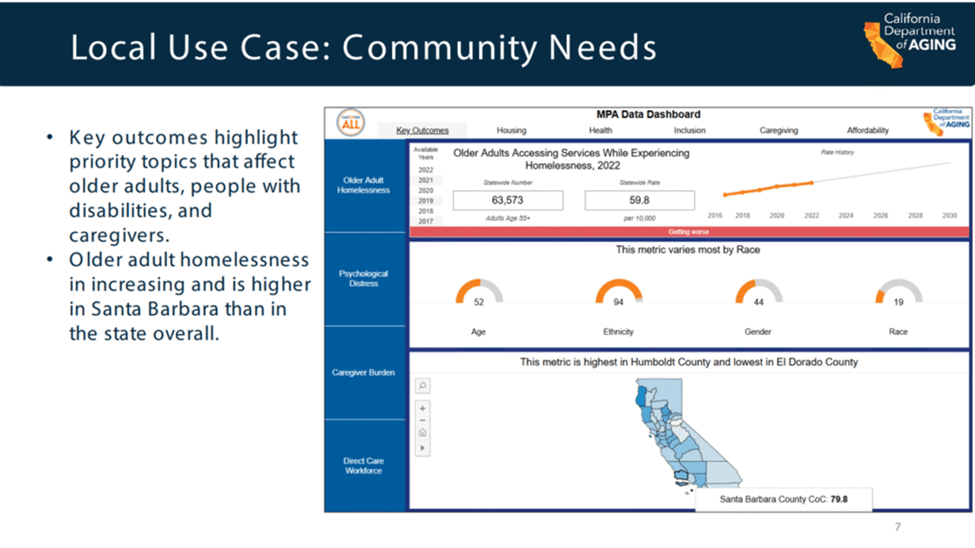
Executives looking to identify market opportunities in the 65+ population will need better data on local needs and service gaps. That challenge was the focus of the session Data-Informed Approaches To Challenges Faced By Aging Services Providers at The 2025 OPEN MINDS Aging In Place Summit. Denny Chan, J.D., managing director of equity advocacy with Justice In Aging; Ross Lallian, chief of research with the California Department of Aging; and Carly Roman-Woo, Ph.D., program officer of the Archstone Foundation discussed how data can help identify unmet need, inform policy, and shape local service design.
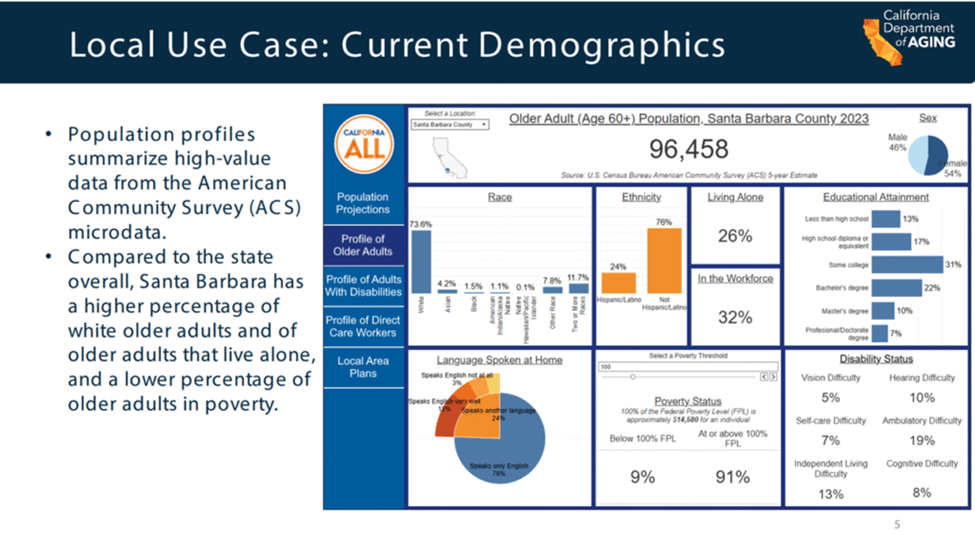
Mr. Lallian described how the State of California is using data to support its Master Plan for Aging, a statewide initiative designed to address the needs of a rapidly growing older adult population. The related public dashboard includes data on housing, health, inclusion and equity, caregiving, affordability, homelessness, psychological distress, caregiver burden, and the direct care workforce. It also allows counties and cities to use the information to build their own local aging plans and dashboards.
That local lens matters. As Dr. Roman-Woo said, “It’s really important to understand not just overall trends, but what’s happening in individual communities.” For provider organizations, that means the aging market cannot be approached as one uniform opportunity. Demand, risk, and service gaps vary by geography.
Dr. Roman-Woo also discussed Archstone Foundation’s work to improve connectivity across health and social service systems. One initiative is a partnership with state agencies and other stakeholders to develop a data exchange framework for consumer health information. The framework is designed to extend beyond traditional medical records and include information on goals of care, medically tailored meals, and specialized supports. The purpose is practical: to reduce fragmentation and ensure older adults do not fall through the gaps between service systems.
Mr. Chan underscored the larger point: “Data tells us how we’re doing and what we can do better.” For executive teams, that means local market data is not just descriptive. It can help identify unmet needs, service gaps, and new opportunities for service line development.
The takeaway is straightforward. Organizations that can gather local market intelligence, understand community-level variation, and act on that information will be better positioned to design services that allow older adults to remain in their homes.