
By Monica E. Oss, Chief Executive Officer, OPEN MINDS
What keeps Medicaid health plan executives up at night? Four issues top the list of barriers to coordinating care for high-risk consumers according to a recent survey – Annual Medicaid Managed Care Organization Survey: High-Risk Care Coordination.
Not surprisingly, 100% of Medicaid plan executives said that meeting the health-related social needs (HRSNs) of their high-risk members was a barrier. And this situation will likely be further complicated by the changing CMS policies on reimbursement for social support services.
Access to care was another key barrier with 95% reporting that access to specialty care was an issue. And access to behavioral health services was a specific concern of 91% of executives, was another.
Interestingly, the ability to contact the member was a barrier cited by 91% of plan executives. This likely is exacerbated by the ‘digital divide’ (the gap between those who have access to technology and the internet and those who do not) coupled with the health plan investment in tech-enabled communication and access tools.
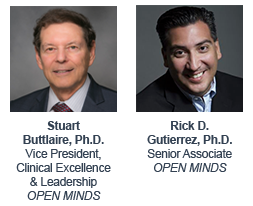
It is in this context that provider organizations serving consumers with serious mental illness (SMI) are looking for models that improve outcomes for consumers and value for health plans. That was the focus of a recent webinar, Health Plan Strategies Reshaping The Economics Of SMI Service Delivery, featuring my OPEN MINDS colleagues Stuart Buttlaire, Ph.D., Vice President of Clinical Excellence and Leadership and Rick Gutierrez, Senior Associate; along with Arden Arslanyan, PharmD, Director, Managed Market Liaison at Otsuka America Pharmaceutical.
The speakers discussed four best practice models for serving consumers with an SMI: the collaborative care model, the intensive community-based case management model, the proactive crisis planning model, and the digital hybrid engagement model. The collaborative care model (such as AIMS and IMPACT) allows primary care clinicians, case managers, and consulting psychiatrists to share a treatment plan and track engagement.
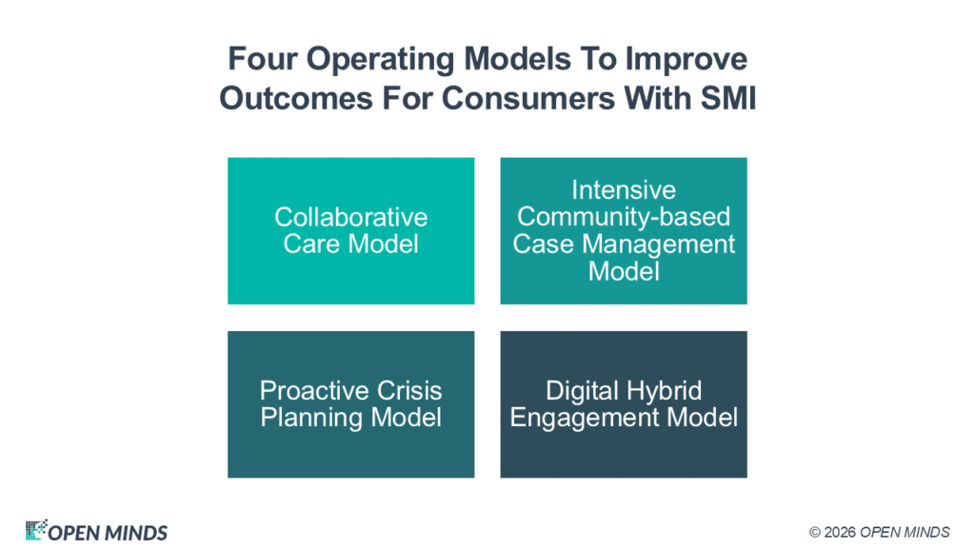
The intensive community-based case management model, including enhanced care management (ECM) and health home approaches, is a high-touch model that meets and supports consumers in the community. These models build proactive care plans and coordinate outreach, engagement, and care across providers and service systems. The proactive crisis planning model focuses on identifying consumers at elevated risk of crisis and developing intervention and response plans before emergencies occur. Rather than waiting for consumers to cycle into emergency departments, inpatient units, or law enforcement encounters, organizations use coordinated care planning and proactive outreach to prevent crises and sustain engagement.
Finally, there is the digital hybrid engagement model that uses technology-enabled communication, monitoring, and service delivery tools to help consumers remain connected to care between appointments and across settings. These approaches supplement in-person care with digital tools that improve access, communication, and continuity.
But as important as these model are, the speakers emphasized that there are two cross-cutting strategies that increase the effectiveness of each model through better consumer engagement: strengths-based engagement and peer-integrated engagement models. The first, strengths-based engagement, focuses treatment planning on consumer capabilities, goals, and resilience factors rather than deficits alone. According to Dr. Gutierrez, a good example of this approach is using the VIA Character Strength Assessment to illuminate and leverage a person’s gifts and strengths to mitigate some of their challenges. This approach is very different than how most clinicians are trained: Instead of focusing on the negatives that need to be reduced, it’s a shift toward identifying available skills and tools. As Dr. Gutierrez explained, “A good treatment plan and a good engagement plan leverage the strengths of that individual. The absence of suffering does not guarantee happiness and flourishing.”

The second, peer-integrated engagement model, uses certified peer specialists to guide consumers as they navigate services. As Dr. Buttlaire noted, “In many programs, peers are the connective tissue that links consumers to services, providers, and recovery supports.” By helping consumers build trust, navigate services, and remain connected to care, peer support improves the effectiveness of each operating model.
But both Dr. Buttlaire and Dr. Gutierrez emphasized that these models can’t succeed without three essential elements: integrated care planning across medical, behavioral health, and social service needs; relationship-based engagement rather than transaction-based care delivery; and financing models that support sustained engagement and better long-term outcomes. “Whatever the model, the common denominator is relationships. The organizations achieving the best outcomes are designing systems that keep consumers connected to care longer. What distinguishes many of these models from traditional service delivery approaches is that they are increasingly being supported by new reimbursement and contracting arrangements,” according to Dr. Buttlaire.
What does success look like? As Dr. Buttlaire described, one intensive community-based case management program he worked with deployed clinicians, case managers, and peers directly to homes, shelters, and emergency departments while providing medication support, appointment coordination, housing navigation, and psychoeducation. The program reduced emergency department and inpatient utilization by 25% to 40% and generated between $8,000 and $15,000 in savings per member per year.
The takeaway from the session was that the right models exist – along with consumer engagement strategies that enhance their effectiveness. But it is critical to convince health plans to reimburse value-based integrated care models that can produce these outcomes. As Dr. Buttlaire put it: “Consumers who remain connected to care, stable housing, medication support, primary care services, and community resources are far less likely to experience psychiatric hospitalization, incarceration, homelessness, or repeated emergency department utilization. And success requires more than just the right clinical services. If you don’t invest in a whole person approach and consumer engagement, you’re investing in disengagement. And that means higher costs, poorer outcomes, and wider inequities.”