By Monica E. Oss, Chief Executive Officer, OPEN MINDS
Whole person care is certainly the goal of most payer and health plan executives—and preferred by consumers. For provider organization executives, the strategic question is how to create (or plug into) integrated delivery systems.
Traditional integration models have focused on providing all services in a single location, using a single electronic health record (EHR) and reimbursed with a single payment system. But technology has changed that equation. Telehealth, interoperability, and consumer engagement technology has created new tech-enabled models for whole person care.
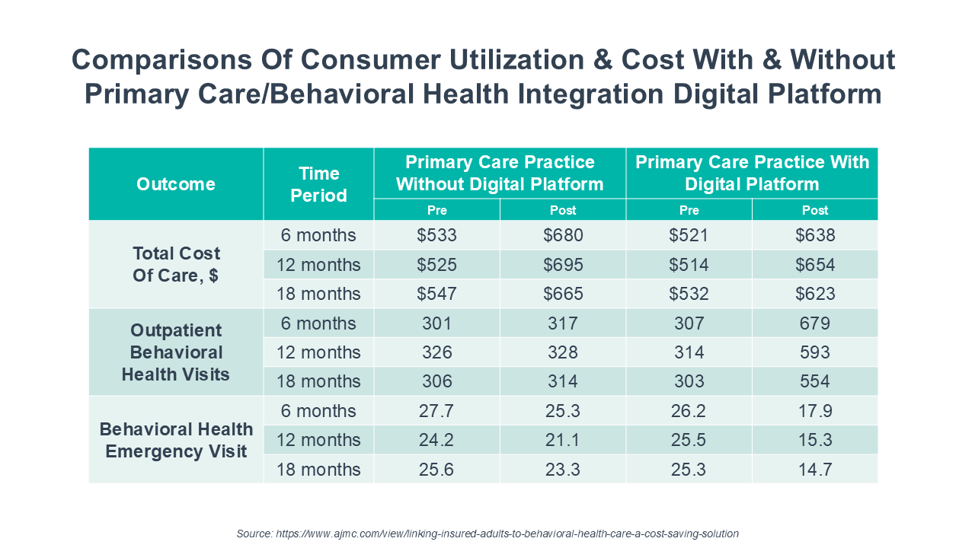
A recent study, Linking Insured Adults To Behavioral Health Care: A Cost-Saving Solution, shows the power of one such tech-enabled integrated care model. The research evaluated the effects of a digital behavioral health platform embedded in primary care practices—with functionality for referral coordination, care navigation, and clinician matching.
When comparing the two sets of primary care practices—one with the platform and one without—at six months, consumers served by the digital platform were 68% more likely to receive behavioral health care. This was likely due, in part, to a time-to-treatment of 34.2 days compared to 53.6 days for consumers without access to the platform—a 36% improvement. Most importantly, total medical costs for consumers in practices with the digital platform were $31.30 per member per month (pmpm) lower in the first six months and $27.63 pmpm lower at 18 months. This reduction in total cost of care was due to use of inpatient care. For consumers served by practices with access to the platform, behavioral health-related emergency department utilization was 35% lower and behavioral health-related inpatient admissions were 43% lower. This data confirms earlier research that a variety of approaches to integration can yield significant improvements in the consumer health and cost of care.