
By Monica E. Oss, Chief Executive Officer, OPEN MINDS
About 40% of cancer treatment programs screen the consumer they are treating for social determinants of health (SDOH) and their health-related social needs (HRSNs). Screening was more likely in Medicaid or uninsured consumers according to new research – Current Practices In Social Determinants Of Health Screening In Commission On Cancer Hospitals.
Of the responding program executives, 44% acknowledged screening added to appointment time, 36% were concerned it would disrupt clinical workflow, 45% cited lack of available staff to conduct screenings, and 42% said they didn’t have a standardized process. Another 44% said they lacked available resources to address identified needs…even as nearly 93% reported having a social worker, and 90% having a navigator program, available to help consumers address SDOH needs.
But the lack of screening for HRSNs was not unique to cancer treatment. Only 28.4% of emergency departments (EDs) reported screening for SDOH. Among EDs with screening policies, 81.6% had response policies in place, primarily utilizing social work consultations. But only 20.5% had an ED-based social worker and 23.4% had around-the-clock social work availability.
Of hospitals, 24.4% reported HRSN screening for all five SDOH factors – and 8.0% reported no screening at all. For physician practices, 15.6% reported screening for all five SDOHs – 33.3% reported no screening for HRSN.
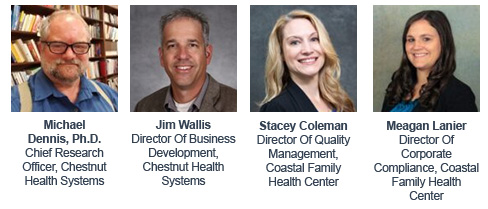
In a heath care environment where ‘whole person models’ and integrated care dominate the discussion, the lack of screening illustrates the gaps between policy and practice in the field. We had the opportunity to hear about integrated care best practices in the session Closing The Loop: Measuring What Matters In Whole Person Care at The 2026 OPEN MINDS Whole Person Care Summit. Chestnut Health Systems’ Michael Dennis, Ph.D., Chief Research Officer, and Jim Wallis, Director of Business Development; plus Coastal Family Health’s Stacey Coleman, Director of Quality Management, and Meagan Lanier, Director of Corporate Compliance, shared the systems they’ve built to align integrated care delivery with measurable outcomes.
Since 1973, Chestnut Health Systems (Chestnut) has provided integrated care service delivery in the U.S., Canada, and internationally via four main service lines – substance use, mental health, and primary care treatment, plus its applied behavioral research, evaluation, and training efforts through Chestnut’s Lighthouse Institute (LI), with over 100 staff and $15 million in revenue.
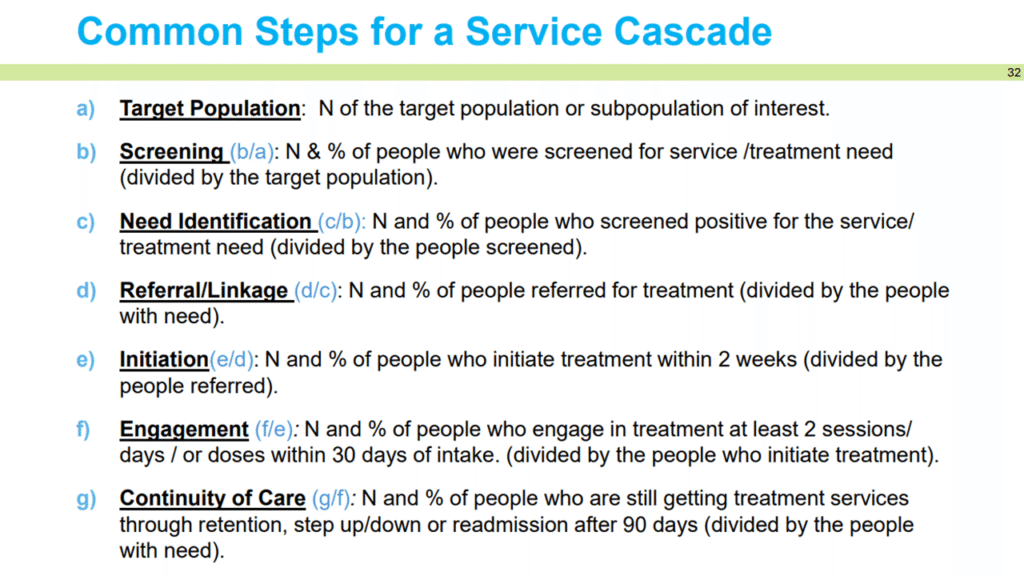
Chestnut’s integrated care model is built on the concept of “service cascades” – a method for understanding movement across health care or social service systems along a desired pathway. The model, first developed around diabetes and infectious disease care screenings, has been adapted for behavioral health and is useful in understanding how well systems are functioning, identifying gaps and shortfalls, and evaluating process improvements.
Using an example from the State of Connecticut’s child welfare programs, there are hundreds of potential ways to move through the system but, akin to a logic model or flow chart, a cascade method proposes, “What do we want to happen? If we gathered team leaders and agreed, what’s the process we’d want to occur?” In an ideal scenario, this could entail a referral or screening, or caregivers and engagement – but the bottom line is it’s the desired process. There may be many ways to get to the end goal, but it’s the desired plan of action.
“Service cascades tend to have multiple steps that help discern target populations. Are we going to screen everybody? How many truly need services? Did they initiate, and then engage, in care?” Dr. Dennis queried. “You can see how accurate the process is, where you might have dropped the ball, and what you want to have happen.”
In studying its own data and results, the Chestnut team noted discrepancies. Some screeners for alcohol and drug use, for example, were better than others. Some screeners didn’t check for co-occurring mental health needs. Yet others didn’t allow for exceptions or deviations from the process. Further, data depicted regions that were struggling because the most severe people were inadvertently sent to the areas with the least intense types of treatment available and vice versa. Taken altogether, this is how and where Chestnut identifies gaps and inconsistencies in care provision.
“Cascades are a way of focusing everybody on the common process and finding out that common thing, which gets us out of silos and more integrated in our care efforts,” Dr. Dennis explained. Added Mr. Wallis, “Our key takeaway from studying these cascade models is that it helps us focus on subpopulations and preferred pathways of care. And that ultimately helps our leadership, better integrations of our electronic health records, and provision of quality care.”
Coastal Family Health (Coastal) is a Federally Qualified Health Center that’s served south Mississippi since 1976 with mission-driven, community-based care regardless of ability to pay. Across 14 stand-alone clinics, one mobile unit, five pharmacies, and 31 school-based sites, Coastal serves over 38,000 patients annually with 116,000 medical, dental, pediatric, behavioral health, lab, radiology, pharmacy, and social services.
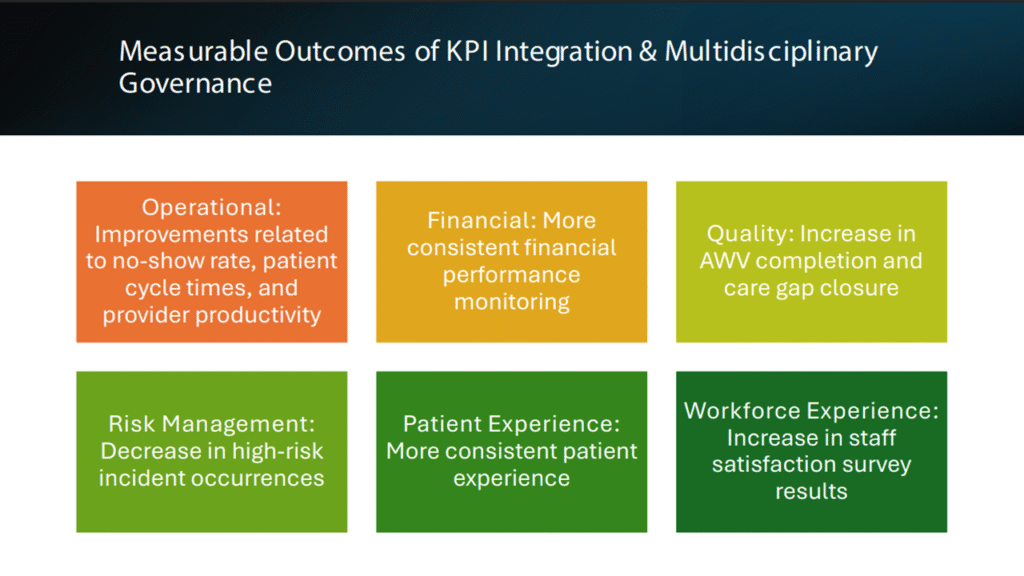
To improve their whole person care initiatives, the Coastal team focused on overcoming internal performance measurement siloes. As Ms. Lanier noted, the quality team focused only on clinical outcomes, the finance team focused on revenue and productivity, and risk management focused on incidents and compliance without widespread, enterprise-level management. This led to a limited understanding of how the performance measures influenced each other and impeded overall performance improvement.
Coastal’s strategic response was to build integrated structures that aligned operations and laid the foundation for formal quality and compliance functions, proactive risk management, and better governance structure. “People started to see how the metrics connected to their daily work,” Ms. Lanier said. “Once we integrated KPIs, we began seeing improvements that cut across departments access initiatives (e.g., annual wellness visits, remote patient monitoring, and telehealth). We’ve been able to see how SDOH and transportation issues are impacting consumer appointments. And we’ve provided that data so our social services representatives can contact those consumers, which has decreased no-show rates.”
The need for both structure and a holistic approach for optimizing whole person care models was apparent in this session. Ms. Coleman put it best: “A friend once said, ‘If everything’s a priority, nothing is a priority.’ If you have all these measures, which one’s key? Communication is critical – sitting with your teams and determining which measures are best to home in on the health of your organization. You have to understand how your data is driving your decisions – and then your governance structures must evolve as the organization grows.”