
By Monica E. Oss, Chief Executive Officer, OPEN MINDS
Certified Community Behavioral Health Clinic (CCBHC) programs are one of many initiatives to move provider organization care delivery and payment to models focused on performance with value-based reimbursement (VBR). Since the model was established in 2017 with 66 CCBHCs operating across eight states, there are now 539 operating in 48 states, plus D.C. and Puerto Rico.
CCBHCs are paid via a prospective payment system (PPS), receiving a single payment each day or month in which a client receives services. This payment is calculated to cover anticipated costs, with rates based on care delivery type and population.
From program inception through 2025, the federal government has provided nearly $3 billion in funding to get CCBHC programs up and running and to support ongoing operations. The question is: What has been the impact of that funding?
A new analysis – The 2026 CCHBC Impact Report – tackled that question, highlighting four key improvement areas. First, access to care has been broadened for children and uninsured persons, with 57% and nearly 48%, respectively, reporting slight-to-substantial increases. Second, more clinics have added buprenorphine and naltrexone to their treatment protocol for opioid use disorder. Roughly 85% of clinics reported either providing both options before becoming a CCBHC, or starting to provide them since becoming a CCBHC. Third, more crisis services have been added to CCBHCs’ scopes as a result of certification. Nearly 41% added mobile response, nearly 30% have added crisis stabilization, and 18% have added call lines. And fourth, nearly a third of CCBHCs now are engaging with VBR agreements beyond the CCBHC prospective payment system (PPS).

To manage the CCBHC PPS and other VBR contracts, provider organizations need a new approach to management – one that involves both financial and clinical acumen. We heard how one organization did just that in its presentation, The Great Divide: Bridging The Gap Between Clinical & Financial Executives at the 2026 OPEN MINDS Performance Management Institute. Volunteers of America Massachusetts (VOAMASS) President & Chief Executive Officer Charles Gagnon and Chief Operating Officer Mindy Miller spoke on how their organization evolved when accepting VBR and shared three lessons learned about unifying their efforts over shared commitment, expertise, and accountability.
VOAMASS is a $50 million non-profit serving individuals with mental health and substance use disorders who are without jobs or homes, as well as those who are chronically underserved or involved in the justice system. They’re also a federal CCBHC-IA (Improvement and Advancement) grant recipient to expand and integrate their behavioral health service delivery model. With a team of 200 recovery support navigators, community workers, case managers, and residential staff, they served over 2,000 outpatient behavioral health consumers in 2025 with therapy, medication management, peer support, and care coordination. Further, with four residential behavioral health programs throughout Boston, VOAMASS has an 80-bed capacity and provides therapy, employment services, links to primary care, and recovery supports.
Their funding model is integrated, with multiple sources supporting VOAMASS’s whole person approach for all populations served. Medicaid, Medicare, Veterans Affairs, and other third-party billing is maximized at every opportunity. Then, VOAMASS negotiates VBR contracts to ensure they get paid for expenses while maintaining a negotiated margin via its care management and care coordination contracts. In addition, more traditional state agency contracts, grants, unrestricted funds, and philanthropic giving round out their funding – used to build capacity and fund non-billable components of the service model.
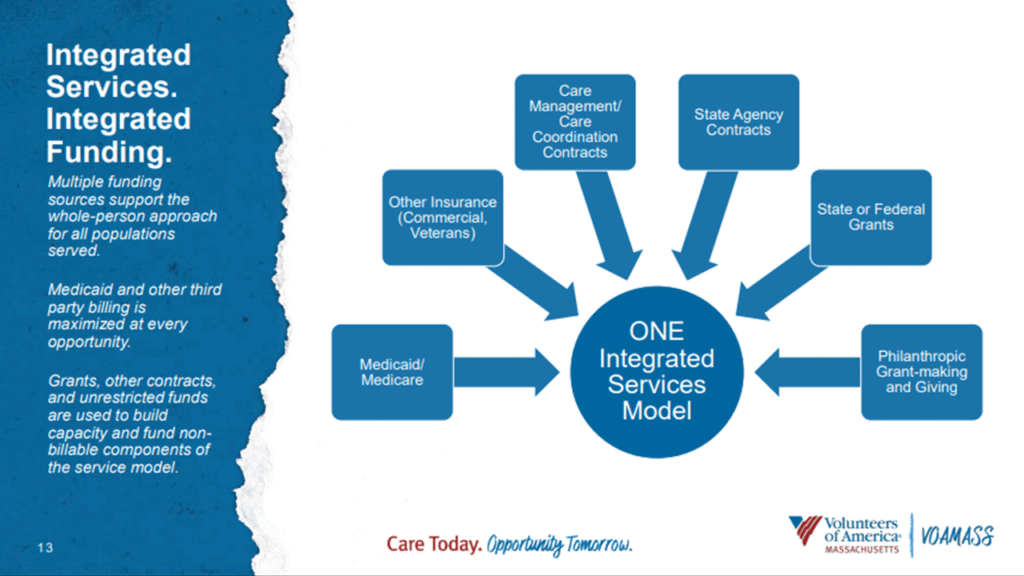
Mr. Gagnon noted it’s helpful to have for-profit entities under the organization’s umbrella to diversify income and revenue streams. “I like to bring together for-profits and non-profits. We have three for-profit assisted living communities, and one for-profit entity that not only delivers at 88% occupancy but sends distributions back to VOAMASS. That diversification means we can really think strategically about how we invest our cash and invest in people,” he shared.
The organization’s efforts focus on three core pillars – health care, housing, and workforce development – integrated in a whole person model across all of its programs. The model yielded great success, but there have been funding challenges. Hoped-for federal and state grant dollars never came to fruition. And they needed to pivot quickly if they wanted their new integrated model to last.
“We had all these amazing plans to get funding around housing and workforce and create social enterprises, and it was going to be wonderful. And then those opportunities never came.” Ms. Miller acknowledged. “And since it was a bunch of operations folks running the show, we had no contingency plan – just ‘our’ timeline, because we were so sure that the work was important enough that someone would fund it.”
To make the budget adjustments, the organization needed to facilitate collaboration between operations leaders (who were focused on the model) and financial leaders (who were focused on sustainability). To do this, they took three key steps to promote and protect their program’s sustainability – sharing commitment, expertise, and accountability.
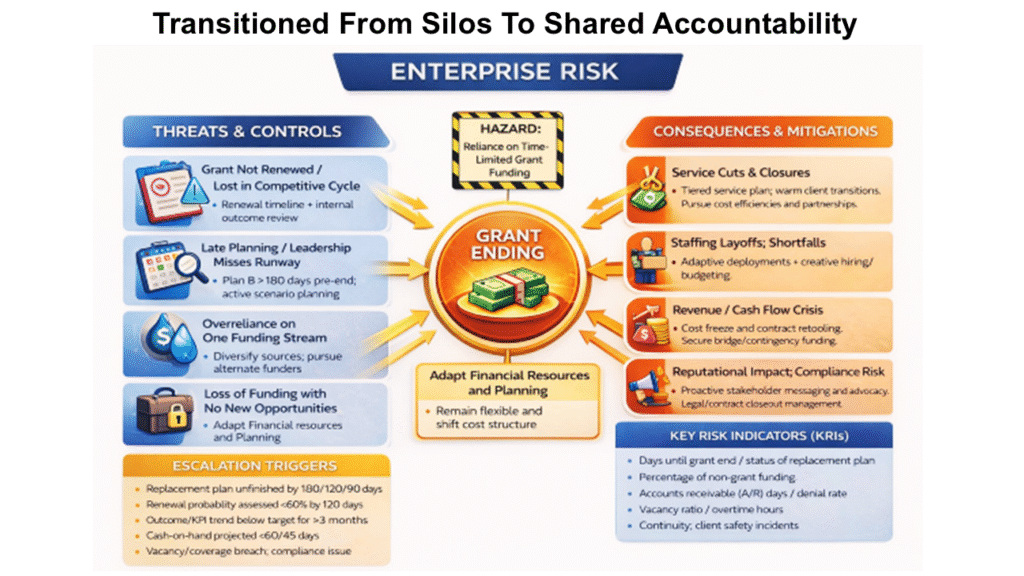
First, shared commitment. For VOAMASS, this meant remaining faithful to their strategic vision and plan, model of care, and sustainability. This also meant moving from competing priorities toward a mutual goal – integrated, whole person care that emphasized health, housing, and employment.
Second, shared expertise. This entailed creating and reviewing sustainability dashboards early and often, and communicating transparently on each side to fill in any gaps (i.e., cross-functional learning). “I’d encourage leaders to try to have a collaborative team. When we launched our whole person care initiative, we set up an integration roundtable that brought all the key players together,” Mr. Gagnon said. “People really appreciate being part of those decisions, and nine out of 10 times we’d reach full consensus.”
And third, shared accountability. Here, joint ownership of outcomes was key. “We learned that Finance and Operations 1000% have to work together,” Ms. Miller noted. “Both groups are very strong problem solvers but oftentimes we’re speaking two different languages, so we have to keep at it. We needed to keep the program content, and we need to keep the services financed. We needed it to be sustainable – and we needed each other to get there.”
In the end, the team remained committed to the model of integrated care through jointly created sustainability dashboards, clear productivity and occupancy expectations, and ownership of budgets and subsequent adjustments. “I’m convinced integrated care is the future of human services – it fits our culture and business model, so we’re not going to change that,” Mr. Gagnon said. “One recent success was receiving three Substance Abuse and Mental Health Services Administration grants which we used to set up mobile teams. So now, instead of consumers having to come to our outpatient office, we can meet them in the park, in their apartment or in a shelter, or over telehealth. Our behavioral health business, which is our cornerstone, took off completely. And it happened while we were transforming the culture of our entire organization.”