
By Monica E. Oss, Chief Executive Officer, OPEN MINDS
Which matters more to consumers – affordability or trust? I was surprised to read in Rebuilding Patient Trust: Where Healthcare Gets It Wrong and How Rising Healthcare Costs Are Fueling a Patient Trust Crisis – that they are more than related.
“Affordability is a huge part of mistrust and of building trust. When we talk to people about the low bar of what they want, they want more transparency into what’s coming their way,” the author writes. “You delay care or go to care because you have to, and then you’re up at night worrying about the bill… We’ve talked to people who don’t even open those bills. They just throw them away because they know they can’t pay them…”
And the use of artificial intelligence (AI) on the internet may also be eroding trust. For over a decade, consumers have flocked to online reviews and ratings of various sorts. But according to a recent analysis – 49% of consumers now believe there are too many fake reviews (with 22% giving AI as their reason). And 82% of consumers believe they’ve seen fake reviews in the past year.
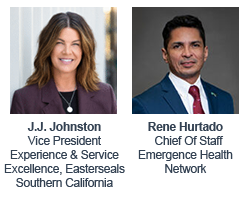
Increasing consumer trust is important to provider organizations for many reasons – trust increases consumer preference and referrals, and trust increases consumer engagement, improving outcomes. We had an opportunity to hear how two provider organizations are tackling these trust issues in Perfecting Patient Engagement & Experience From Beginning To End, which took place at The 2026 OPEN MINDS Service Excellence Institute. J.J. Johnston, Ed.D., Vice President, Experience & Service Excellence, Easterseals Southern California (Easterseals), and Rene Hurtado, Chief of Staff, Emergence Health Network (Emergence), presented two approaches to listening and learning – one human-focused, the other data-focused.
Easterseals is a $535 million non-profit organization started in Los Angeles in 1926 to provide essential services to individuals with disabilities. Now spanning eight counties in southern California, Easterseals offers over 75 service sites and 3,000 staff who provide autism, child development, independent living, employment, and adult day services to some 31,000 consumers and their families.
Emergence is an $80 million non-profit in El Paso, Texas, that serves youth, veterans, and residents with mental illness, intellectual and developmental disabilities (I/DD), and substance use disorders to improve quality of life and independent functioning. Founded 60 years ago, Emergence’s 750-member team now serves an estimated 25,000 consumers annually, including by acting as a 988 call center for 57 counties across west Texas.
To learn where their consumer journey created the most friction and to improve consumer trust, Easterseals’ approach was to listen to families. Their team conducted over 3,000 support calls and documented nearly 4,500 concerns from January through June 2026. They learned that consumers experienced the organization as a single journey and not separate programs, so communication, navigation, and clarity were as critical as service quality.
“We offer amazing services, but the issue was how the journey felt and functioned for the participants,” Dr. Johnston said. “Experience isn’t a measurable metric, but people know whether how they were taken care of made them feel safe, supported, and heard.”
Easterseals coined this effort as “Customer Success” and designed it as an organizational capability – not customer service or complaint management, but rather a proactive way to reduce friction. Leaders mapped contact points, conducted listening sessions, and facilitated cross-functional conversations to eliminate silos and speed bumps, and smooth the handoff process. Embedding experiences into quality reporting changed the team’s conversations from “How did they feel?” to “How did we perform?”
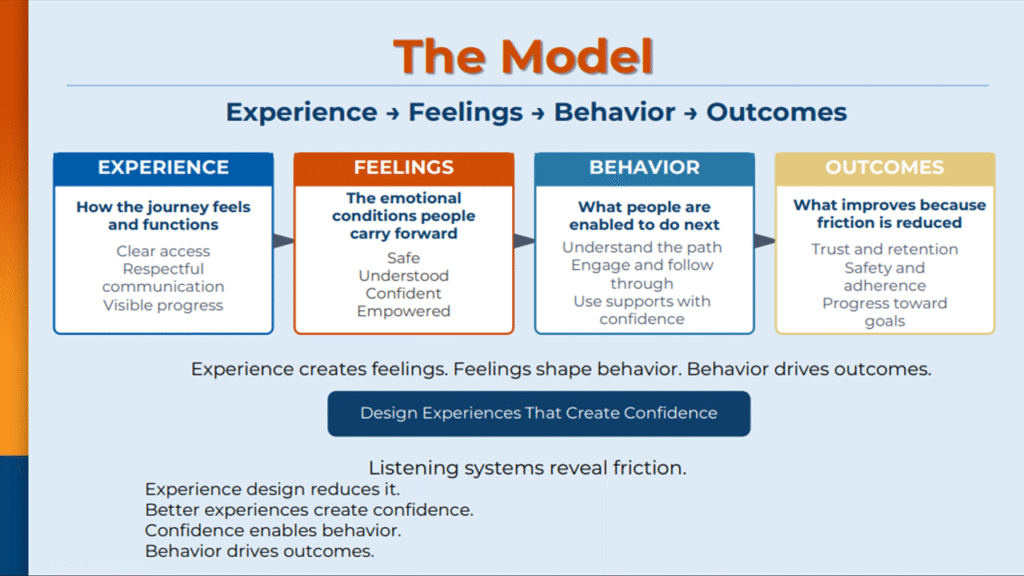
Dr. Johnston noted several key lessons learned through this process – that experience begins before services, consumer experience is everyone’s responsibility, and outcomes and experience are inseparable.
“Organizations that are listening effectively are organizations that are improving efficiently. If we’re evolving based only on assumptions, it’s all going to fall apart,” Dr. Johnston cautioned. “Our listening system is truly how we find opportunities for improvement.”
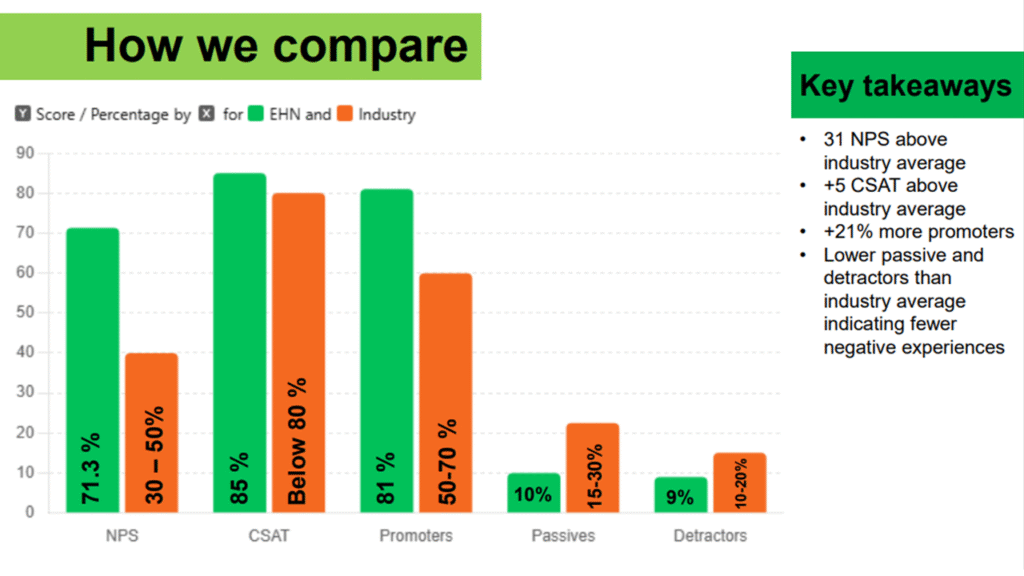
Emergence has invested in a data-driven approach to building a better consumer experience. Their Patient Satisfaction Initiative has entailed identifying and mapping customer touchpoints – from initial telephone calls and appointment setting to discharge or termination of services – through surveys created specifically to produce valuable administrative data as well as areas for improvement and expansion. And to gauge their service offerings and efforts, they’ve incorporated Net Promoter Score (NPS) and Customer Satisfaction (CSAT) measurements into their process.
To operationalize the survey process, they’ve created multiple surveys (and ultimately will create versions for 31 different locations). Clinic managers provided supporting input as the team spent considerable time ensuring certain parameters were met (e.g., bilingual capabilities and data sufficient enough to support accreditations or funding) while also tracking consumer experience. Questions were created around certain data points like access to services, appointments, reminder calls, office coordination, intake, nursing, medication management, discharge, and transfer. They also developed an algorithm that prevented them from over-surveying for particular groups or data points, thus sidestepping the survey fatigue that so many consumers report today.
“Our surveys are randomized and track along patient journeys – veterans, mobile crisis, law enforcement, outpatient clinics. So even though there are multiple options, a consumer would be asked only about one or two touch points at a time,” Mr. Hurtado explained.
By reviewing consumer experience data in weekly meetings and monthly roundtables, Emergence has been able to address concerning feedback. Overall results have been positive: The team reports high CSAT scores around hours of operation (89%), ability to get appointments (83%), and consumers’ intake experiences (~90%), with an NPS that’s 31% above the industry average.
“We’re a unit of local government, so we have to be as transparent as possible. One of our primary surveying goals was making sure data would be usable by leadership. They needed tangible information to make functional changes to their day-to-day operations and better the consumer experience,” Mr. Hurtado said. “It’s still a work in progress, but with regard to making operational changes and strengthening consumer satisfaction around clinical operations, we feel we’ve met our goals.”
And as the opening author noted, when it comes to rebuilding consumer trust, meeting collective organizational and interpersonal goals is key.” (When consumer trust is restored), the number one thing people would feel is that they’ve been listened to and heard. I think we would have a more expansive view of health…a more complete view of what it means for someone to be healthy. …And I believe…it would be more affordable.”