
By Monica E. Oss, Chief Executive Officer, OPEN MINDS
There has been a lot of discussion in recent weeks about applied behavior analysis (ABA) – like CMS Issues Outline Of Suggested State Medicaid Autism Therapy Oversight and Minnesota Medicaid Autism Treatment Authorization Backlog Reaches 1,000 Treatment Plans. But advancements in developmental psychology, neuroscience, and experiential data for autism spectrum disorder (ASD) have expanded the discussion. ASD is should no longer be treated as a single disorder but rather a highly heterogeneous neurodevelopmental condition, according to a new analysis, Autism Care: Reimagining The Spectrum. The challenge is how to assure that treatment plans and benefit plans follow suit.
Since many people with autism also meet criteria for complex care needs, treatment requires an interdisciplinary approach that incorporates services across health, educational, and community systems. The report suggests that reframing the ‘autism spectrum’ from a hierarchy of symptoms to a more intervention-oriented ‘spectrum of care’ better aligns services with the ‘whole person’. And there are real-world studies that support this personalized, multidisciplinary approach to intervention.
For provider organizations, this means a broader ranges of services and coordinated treatment goals. For payers and health plans, they will require value-based, outcome-driven reimbursement options beyond the old standard, ‘single disorder’ billables.

We had the opportunity to hear how a leading health system is implementing its ‘spectrum of care’ during Integrated Behavioral Health In Action: Lessons From Kaiser Permanente’s Whole Person Care Model, which took place at The 2026 OPEN MINDS Service Excellence Institute. Dr. James E. Tong, Assistant Regional Medical Director, Care of Children Service Line Leader at Kaiser Permanente (Kaiser), shared how the emphasis on integrated care is helping meet the needs of a growing population with autism.
Dr. Tong views integrated care like a buffet, where options are available in one place, with one kitchen behind the scenes; consumers can choose what they want and pay one price for it all. At Kaiser, integrated care is coordinated, data-connected, and value-driven; it’s shared accountability across primary, specialty, and behavioral health care, supported by common clinical information and aligned incentives around the member. Core ‘ingredients’ include a united provider network, shared electronic health records (EHRs), value-based contracts, care management teams, and quality and safety standards. Instead of consumers having one-off visits, they travel a well-coordinated pathway toward a better experience and lower total cost of care.
“Kaiser’s buffet of services is an organized network of primary, specialty, and behavioral health providers alongside community resources,” Dr. Tong explained. “That puts consumers in the middle, which is really our primary focus.”
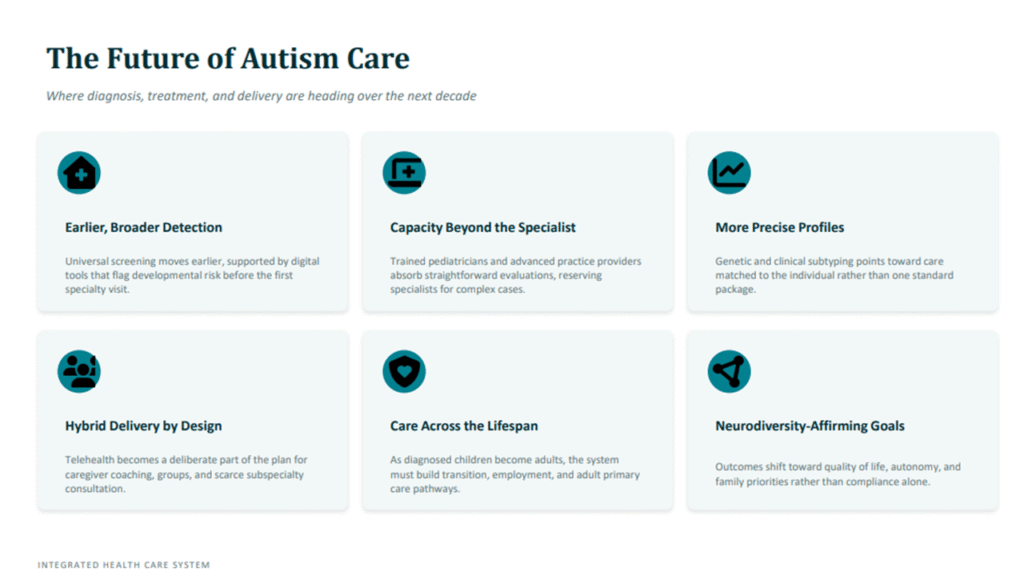
This model has taken on a new importance with the rise of autism diagnoses. Kaiser’s membership in southern California comprises nearly five million members, with nearly one million under the age of 18. They employ about 500 general pediatricians and 30 developmental-behavioral pediatrician specialists. In a different era, this might have sufficed but levels of autism are increasing. In 2000, the rates of autism in eight-year-old children were about one in every 150; by 2022 it was one in 31 – roughly a fivefold increase.
To meet this growing need, Dr. Tong shared three main ways Kaiser has structured its treatment model – by using an integrated network of services, providers, and referrals; focusing on whole person care; and combining treatment modalities (including ABA) to prepare consumers for long-term health and independence.
First, Kaiser’s integrated network of services, providers, and referrals reinforces the principle of ‘many doors, one diagnosis.’ Myriad behavioral and developmental referral routes – from families, pediatricians, school districts, regional centers, and therapists – all converge toward a diagnosis of autism.
“Our system is really based on the notion that autism cannot be fully managed by a single specialist alone,” he said. “And this is where the ‘buffet’ – the one-stop-shop – comes in.”
Kaiser has created a model in which everything a consumer needs is coalesced within a system of connectivity. A single point of entry, co-located services for convenience, warm hand-offs between services, and a shared EHR point toward more coordinated scheduling.
And this multidisciplinary team approach offers a referral pathway. To extend its evaluation capacity, Kaiser utilizes trained primary care pediatricians who can evaluate straightforward cases and begin autism services quickly. Advanced practice providers (e.g., nurse practitioners and physician assistants) in clinic settings can provide evaluation visits, family counseling, and follow-up care. And ultimately, their specialist-supervised model utilizes developmental behavioral pediatricians who review complex cases and support the wider team while providing in-person care for consumers who need it most.
Second, Kaiser focuses on the whole person, reinforcing the ‘spectrum of care’ approach. Since approximately 70% of consumers with autism also have at least one co-occurring psychiatric condition (e.g., attention-deficit/hyperactivity disorder, anxiety, depression, sleep disturbance, obsessive-compulsive disorder, aggression), Dr. Tong warned against ‘diagnostic overshadowing’ (i.e., attributing all problems to an autism diagnosis) and promoted screening and addressing consumers’ mental health when planning treatment.
This then broadens the care plan: At Kaiser, they do mood, anxiety, attention, and sleep screenings routinely, not just once. They’ve added psychiatry to their team (e.g., behavioral supports, medication, etc.), and also track one plan across every setting such that behavioral, medical, and school teams are focused on the same goals, which all reinforce ABA and therapy plans.
And third, this emphasis on combining modalities (including ABA) best prepares consumers and caregivers for long-term health and independence. ABA offers early, structured, and individualized therapy that builds communication and daily living skills. And when employed alongside parent-mediated training, peer groups, and social skill instruction, ABA supports growth and helps monitor goals.
Toward this end, Kaiser’s Q1-26 statistics, from ASD referral to first visit, show that nearly 80% of their ABA assessments are completed within 14 business days. ABA treatment visits are offered post-assessment within 13 business days. Of these visits, 99.8% ABA therapy appointments were conducted face-to-face, with 0.2% utilizing telehealth. For social skills work, 74% of visits were conducted in face-to-face group sessions, where peer practice works best, with the remaining 26% as group sessions conducted via telehealth for those families farther away from a treatment site.
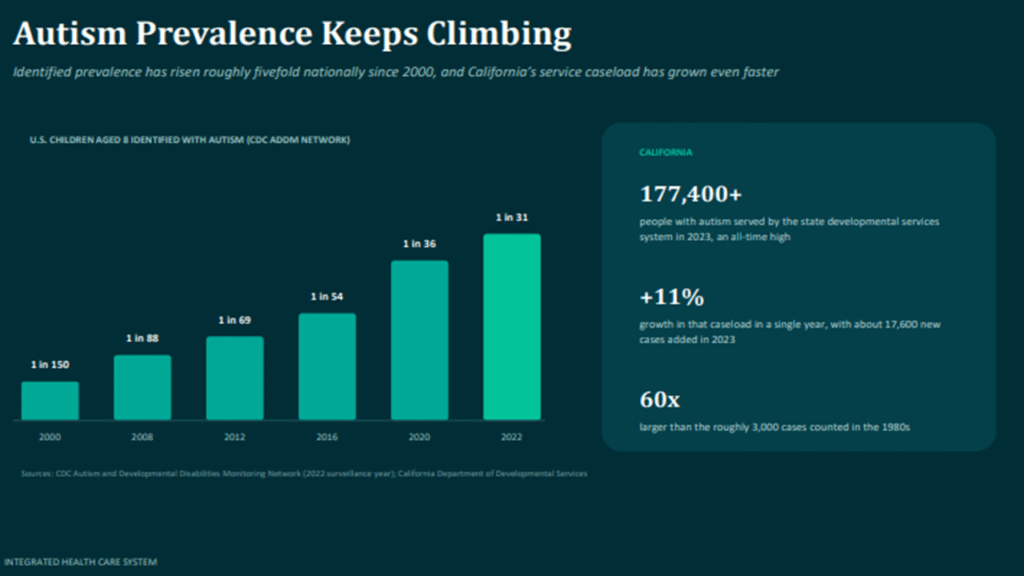
But even as Kaiser is promoting integrated care for autism, challenges remain. Increasing prevalence requires more specialists than are currently available. And systems have to extend specialist expertise via primary care and advanced practice clinicians, through the building of multidisciplinary teams, and by organizing around the whole person rather than a series of disconnected services. Changing regulatory environments, governance silos, and data privacy and security also are barriers to cohesive care. Thus, continued focus on early detection, hybrid delivery systems, capacity and team growth, co-occurring disorders, and transitional pathways is the only way forward. According to Dr. Tong, ‘outcomes’ in autism are very nebulous, but can mean functional and quality of life improvements, greater independence and autonomy and, as appropriate, lesser need for intensive services. In his mind, utilizing whatever modality is most efficacious is key.
“Our biggest asset is our people, so my advice would be to get people in the same room. At the end of the day in developing this care, we’re all smarter together,” he encouraged. “We also do a lot of access- and satisfaction metrics, because we want our consumers to want to come back to the buffet. Yet while treatment plans are individualized for each member, ultimately our goal is to take care of all their needs.”