
By Monica E. Oss, Chief Executive Officer, OPEN MINDS
“When an autistic child goes missing, every minute matters,” said U.S. Department of Health and Human Services (HHS) Secretary Robert F. Kennedy, Jr., announcing the first-ever National Autism Missing and Endangered Person alert initiative last month – HHS Launches First National Autism Missing And Endangered Person Alert Initiative. HHS, in concert with the U.S. Department of Justice (DOJ) and the Federal Emergency Management Agency (FEMA) under the Department of Homeland Security (DHS), will coordinate the nationwide preparedness and response initiative while also releasing a broad set of collaborative actions aimed at improving safety, health care, and services available to autistic consumers at every stage of life according to the announcement.
This initiative will improve the response and coordination of emergency management agencies to increase positive outcomes for autistic individuals who are reported missing. It also allows for a best practices framework to target leading causes of preventable injuries, such as elopement, suicidality, accidental drowning, and injuries caused by physical restraints.
In the past month, there was another federal autism-focused initiative – the Centers for Medicare & Medicaid Services (CMS) released a new policy toolkit for state Medicaid agencies – State Medicaid & Children’s Health Insurance Program Applied Behavioral Analysis Toolkit. Among many topics, the toolkit covers clinical standards, utilization management guidelines, Medicaid benefits, coding, and professional qualifications. The toolkit authors state that the toolkit is “not a regulation,” and “should not be interpreted as establishing a standard of care or directing clinical judgment,” and “does not endorse or require any particular treatment modality.”
The recommendations in the toolkit were accompanied by a wide variety of CMS statistics on autism spectrum disorder (ASD) service utilization in Medicaid – including the fact that Medicaid & CHIP spending for autism increased 421% from 2021 to 2025. But the numbers on total spending increases have nuance. And the data-driven backstory to the numbers were the focus of our new OPEN MINDS Market Intelligence report – Medicaid Utilization & Spending For Autism Spectrum Disorder: An OPEN MINDS Market Intelligence Report.
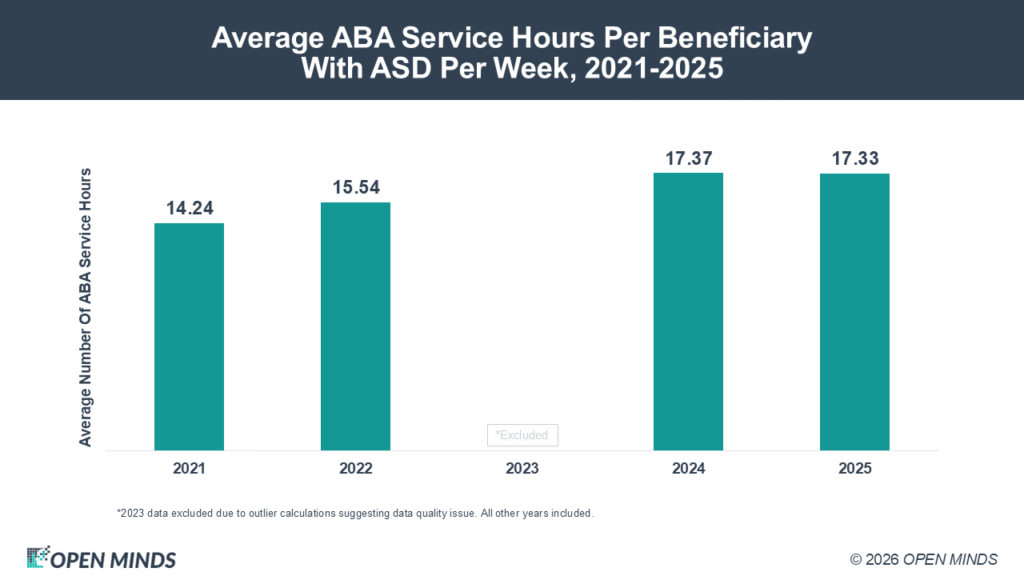
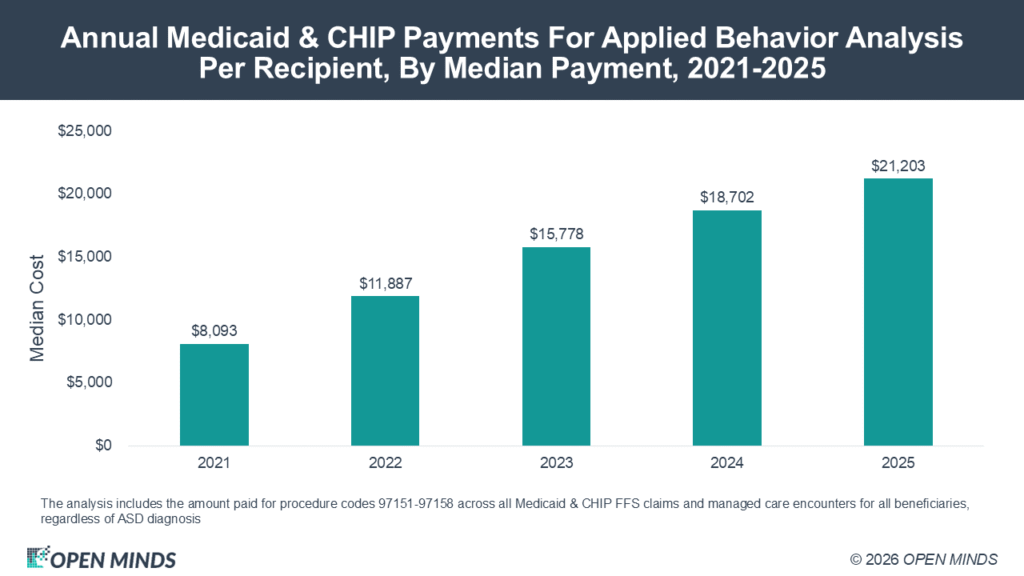
From 2021 to 2025, average service hours per beneficiary with ASD per week increased from 14.24 hours to 17.33 hours (22%) while beneficiaries with ASD receiving Applied Behavior Analysis (ABA) increased by 189%. This resulted in annual payments for ABA per recipient increasing from $8,093 to $21,203 (162%). At the same time, 77% of total Medicaid & CHIP payments for ABA services were covered by Medicaid managed care plans in 2025, compared to 63% in 2021.
The question for provider organization executives is what these trends mean for service delivery systems, reimbursement, and future market demand. I asked my OPEN MINDS colleagues for their perspective.

According to Stuart Buttlaire, Ph.D., Vice President of Clinical Excellence & Leadership at OPEN MINDS, “The growth in spending cannot be attributed simply to more consumers receiving services or to higher weekly service intensity. Reimbursement rates, length of treatment, service mix, and other utilization patterns also contribute to the increase.”
Dr. Buttlaire noted that ABA spending has become heavily concentrated in technician-delivered treatment. In 2025, approximately $7.78 billion was paid for CPT code 97153, adaptive behavior treatment delivered by a technician under an established treatment plan. That represented 77.7% of the spending across the four major ABA codes analyzed. At the same time, most payments for ABA are now made by health plans. Managed care ABA payments increased from $1.23 billion in 2021 to $7.79 billion in 2025 (about 77% of total spend) while fee-for-service payments reached $3.83 billion in 2024 before declining to $2.31 billion in 2025. “When most spending is controlled by health plans and nearly four-fifths of the major-code spending is concentrated in one technician-delivered service, utilization management, rate policy, and workforce economics become inseparable.”

Michael Allen, Executive Vice President at OPEN MINDS, sees that as the immediate financial risk for provider organizations. “With managed care now handling most ABA payments, and payment per recipient rising faster than service intensity, provider organizations should expect health plans to start tightening authorization criteria, rate negotiations, or utilization review. Specifically, organizations should model what a change in rate or tightening of medical necessity for CPT 97153 would do to their revenue, since that code is driving most of the growth.”
But reimbursement pressure is not the only strategic issue in the data. Mr. Allen noted that the age distribution raises a longer-term question about where future autism-related spending will occur. In 2025, 127,591 Medicaid and CHIP beneficiaries with ASD receiving ABA were ages three to five, and another 120,121 were ages six to 11. That dropped to 32,894 among ages 12 to 17, 5,702 among ages 18 to 20, and just 2,615 among those age 21 and older.

For Terence Blackwell, Jr., Senior Associate at OPEN MINDS, the concern is what happens as today’s pediatric ABA population ages into systems with far fewer community-based treatment options. “Most surprising is the failure to provide ABA services to the ‘transitioning’ population, kids going out of school, and the adult population. That is where huge cost is going to hit. Without differential in pay, agencies are going to continue serving little kids and not the adults with much more challenging behaviors.”
If appropriate behavioral supports are not available as children with ASD transition into adulthood, those needs do not disappear. They can instead shift into higher-cost residential, crisis, disability, and long-term support systems. As Mr. Blackwell put it, continuing to build a system concentrated primarily on young children while the population ages creates “a tsunami in the making.”
The question for provider organization executive teams is how to adjust strategy to new market perceptions. On the financial side, Mr. Allen recommends understanding how much revenue depends on CPT 97153, which payers account for that revenue, and what changes in reimbursement or authorization levels would mean for margin, staffing, and service capacity. On the clinical side, Dr. Buttlaire recommends reviewing treatment duration, diagnostic mix, medical necessity documentation, supervision, reassessment practices, and outcomes before those issues become the focus of payer review.
The strategic issue is whether provider organizations can demonstrate that they are delivering the right level of care, for the right duration, with measurable results, while adapting to a reimbursement environment under increasing scrutiny. As Dr. Buttlaire put it, “Organizations that can demonstrate both clinical value and responsible stewardship of resources will be in the strongest position with health plans and state Medicaid agencies.”