
By Monica E. Oss, Chief Executive Officer, OPEN MINDS
The data on the need for social supports – particularly around the impact of housing insecurity – are well documented. People experiencing homelessness (PEH) have far greater physical concerns, mental health needs, and socioeconomic challenges compared to those who have never experienced homelessness. And they have higher average health care expenditures.
In fact, 53% of PEH experience overweight or obesity (17% higher than those who were never homeless), 22% have hypertension (46% higher), and 9% have asthma (50% higher). Further, mortality rates among PEH can be up to 10 times higher than those reported in the housed population. Unmet health needs (reported by approximately 73% of PEH) and delayed care contribute to high rates of emergency department visits and avoidable hospitalizations. In the U.S. alone, annual health care costs for PEH are estimated to exceed $30,000 per person, largely because of fragmented and reactive care delivery.
The recent metrics on U.S. homelessness will likely have an impact on total health care spending. From 2019 to 2025, the number of people experiencing homelessness increased by over 30% according to a new analysis – Five Key Facts About People Experiencing Homelessness.
There is good news. The 2025 estimate of approximately three-quarters of a million people (746,000) who are homeless at any point in time shows a decrease of 3% from 2024 levels.
But the more granular metrics have implications for planning. The share of homeless people who are identified as experiencing ‘chronic homelessness’ (defined as having a disability – physical, mental, developmental, substance use, or HIV/AIDS-related – and experiencing episodes of homelessness of at least 12 months) increased from 19% in 2019 to 23% in 2025. The share of this population who are veterans fell from 8% in 2019 to 5% in 2025 (from about 37,000 to 33,000).
And of those individuals who are homeless, nearly six in ten (56%) are staying in emergency shelters and nearly one in ten (8%) in transitional housing. And about seven in ten (67%) individuals experiencing homelessness were people of color.
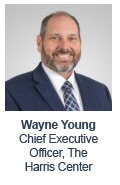
For health plans and provider organizations focused on whole person care models, understanding housing insecurity – and available resources in each community – is an important factor. We got to hear how one provider organization is integrating addressing health-related social needs like housing in their model during the session Beyond The Blueprint: Real-World Case Studies In Implementing Whole Person Care, presented during the 2026 OPEN MINDS Whole Person Care Summit. Wayne Young, then Chief Executive Officer, The Harris Center, shared his team’s experiences and offered advice for other organizations that want to refine their whole person care models
Based in Houston, The Harris Center is a $375 million non-profit, the largest provider of community-based behavioral health and intellectual and developmental disability (I/DD) services in Texas. In 2025, their 2,600-member team provided over two million services to 89,000 individuals and answered 336,000 crisis calls. Between emergency and residential services, criminal justice collaborations, crisis response, outpatient services, and integrated health care, The Harris Center provides care at 14 distinct locations.
One of its strategic initiatives has been to create The Harris Center for Integrated Care. This initiative is focused on improving integration of behavioral health, I/DD, and primary care collaboration, serving unhoused individuals with a history of mental illness or I/DD, and improving care pathways for clients with I/DD in Harris County Jail locations. In addition, the organization’s executive team targeted opportunities to expand integrated care partnerships with managed care organizations.
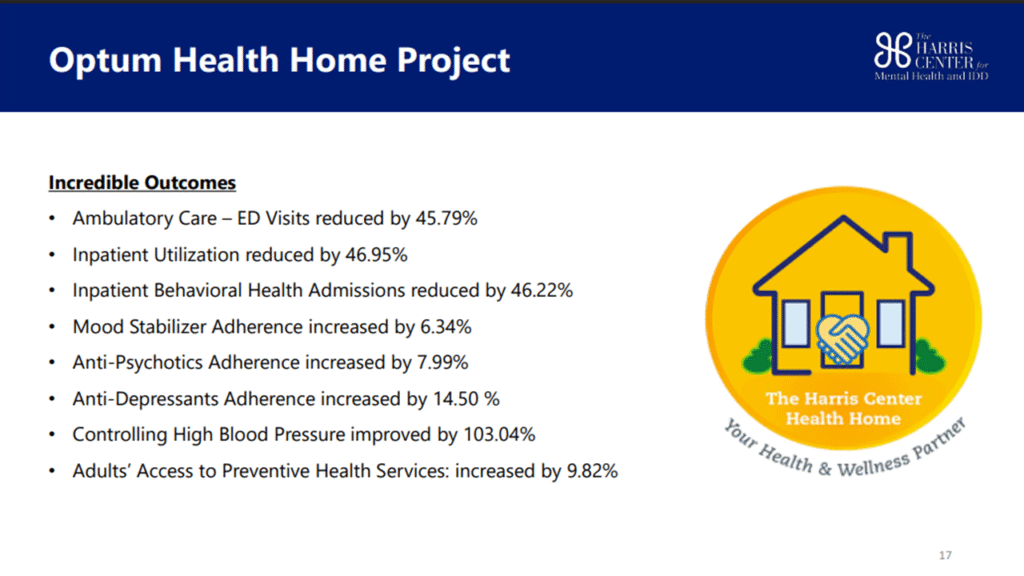
One illustration of Harris Center’s commitment to and success with integrated care is their health home initiative with Optum. This program targets 1,500 of the highest-risk Optum members, those with over $100,000 in annual health care spending. By focusing on care management with risk stratification and addressing social determinants of health (including housing), the partnership has yielded nearly 50% reductions in both emergency department visits and inpatient hospital utilization.
For other provider organizations looking to have the same sort of impact, Mr. Young offered four key guidelines. These include enlarging the tent, braiding funding, capturing good data, and partnering with outside experts.
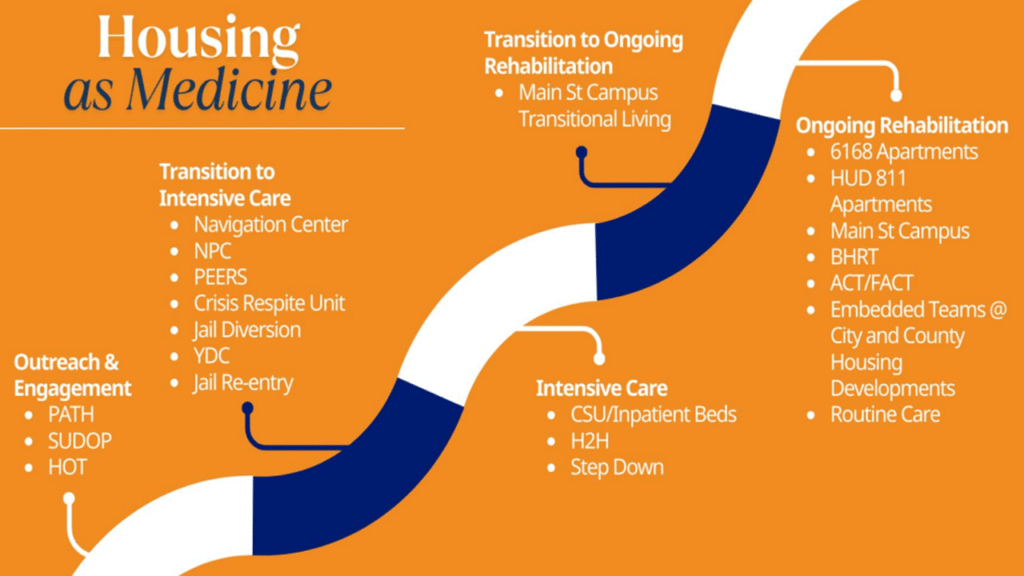
First, ‘enlarge the tent.’ By this, Mr. Young stressed the need to broaden access, increase entry points into the system, and coordinate with others. “We rely on case matching with the Patient Care Intervention Center Database, which merges data from multiple medical, mental health, social service, and criminal justice sources, to detect overlapping use of services. Some people received services from as many as eight different systems,” Mr. Young said. “There’s no way to coordinate that care alone across so many organizations, so we partner with others to help champion folks’ health and integrate them into care.”
Another key is developing the ability to braid funding. Mr. Young suggested anchoring funding from many sources, so if one is threatened or at risk, it doesn’t stop the mission. “If you’re looking for one single pot of money that will give you confidence and security and safety in doing this kind of work, I think you’ll be waiting a long time.”
Third, capture good data, which Mr. Young considers crucial. “There has to be this mindset of continuous quality improvement, and that starts with referencing data. We’re working right now on kind of a risk stratification and trying to think about how we engage intentionally and strategically with the right interventions based on risk profiles.”
And finally, don’t reinvent the wheel. “I rely on outside expertise. It’s not that we couldn’t have learned what we needed on our own but, man, it would have taken us a long time,” Mr. Young acknowledged. “So I am not shy about trying to leverage other people’s expertise and letting them help us get farther along our path.”