
More than half of adults with I/DD have an anxiety diagnosis (57.2%). Nearly as many have a depression diagnosis (57.1%). Among adults without I/DD, just 10.6% and 9.9% carry those diagnoses, according to a recent study, Anxiety, Depression, And Care Barriers In Adults With Intellectual And Developmental Disabilities.
But the differences in mental health treatment for adults with I/DD go beyond prevalence. More than four in ten consumers with I/DD and anxiety (41.7%) reported using a medication for anxiety, compared to 8.6% of adults without I/DD. And for consumers with I/DD and depression, 38.2% reported taking depression medication, compared to 6.0% of adults with depression without I/DD. The differences in counseling were just as wide: 41.4% of adults with I/DD and anxiety or depression engaged in counseling, compared to 9.0% of adults without I/DD.
Despite these differences in treatment, the access data complicate the picture. Among adults with I/DD and a behavioral health condition, 17.9% reported delaying therapy due to cost and 9.2% reported going without it. The comparable figures for adults with behavioral health conditions but without I/DD were 3.5% and 3.2%, respectively.

This study and others point to the need for new approaches to treatment for consumers with I/DD. And in their recent presentations, What Actually Works: Monarch’s Integrated Care Model For I/DD & Co-Occurring Behavioral Health & Substance Use Disorders and Co-Created Solutions: The Best Of The 2026 OPEN MINDS Autism & I/DD Executive Summit, Monarch CEO Peggy Terhune, Ph.D., and Medical Director for Specialty Populations John Latz, M.D., described their new integrated care model for these consumers. “We used to be an I/DD-only company,” Dr. Terhune told the room. “We now provide services for people with behavioral health, addiction, and traumatic brain injury (TBI) as well. Why? Because if you don’t do that, you become the specialty organization that goes away.”
Adults with I/DD routinely go without mental health and physical health care. Monarch found few therapists trained to work with the population, psychiatric visits limited to quarterly medication checks, and prescribers defaulting to sedation rather than looking for the medical or environmental cause behind a behavior.
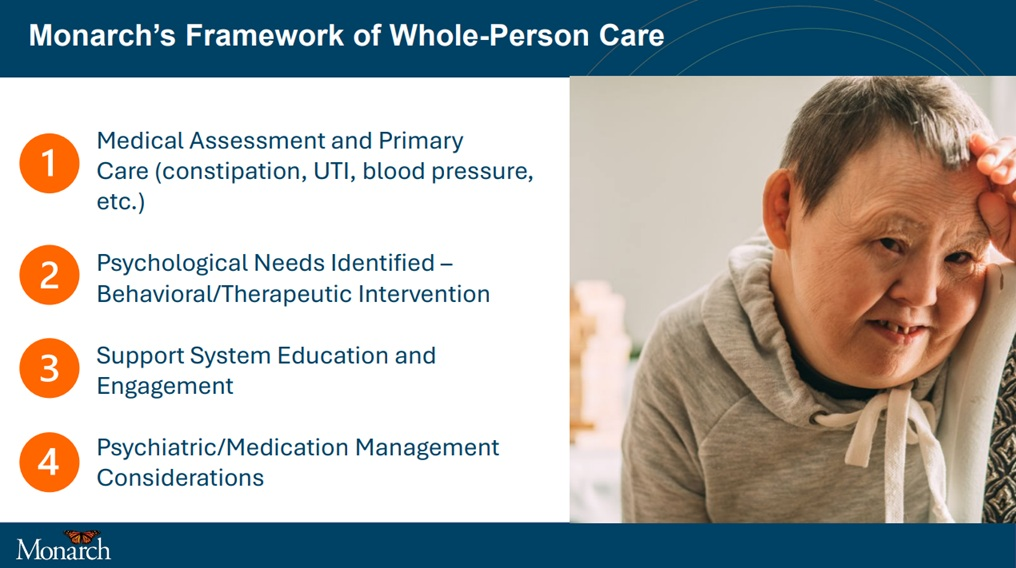
The Monarch model’s foundation begins with a thorough medical assessment as part of their framework of primary care delivered by psychiatrists co-trained in both physical and psychiatric care. Their services include behavioral and therapeutic intervention, support system education, and targeted medication management. Their team approach treats input from direct support staff as equal to that of clinicians. Remote monitoring technology and a co-developed addiction curriculum for people with I/DD round out the model.
Building on that, Dr. Latz pointed to what makes or breaks the expansion in practice. “It’s so easy for the physician or your mid-level on call to treat the symptom and not the cause,” he said. His prescription is fewer layers between the consumer and the decision, and a faster cycle (observe, orient, decide, act) run by direct support staff who treat behavior as communication rather than a problem to suppress. “We’re not treating them specially because they’re I/DD,” Dr. Latz said. “We’re treating that core biological neuropharmacological issue.”
According to Dr. Terhune, what makes the model durable is that it’s wired into operations rather than confined to mission statements. The speakers offered operational figures rather than formal outcomes data, and the figures make the case. Remote monitoring eliminates overnight staffing for much of the residential population who do not require awake supervision at night, which turned a recurring labor cost into a one-time technology expenditure of roughly $7,000 to $10,000 per home.
The Understanding Addiction and Developmental Disabilities curriculum, free and co-developed with 15 people who have I/DD and substance use disorder, was built to fill a training gap others had ignored. The approach supports an organization serving 30,000 people annually on a budget of about $135 million, with operations in two states and expansion underway.
The session framed integrated care as market positioning. As payers tighten around total cost of care, a population with several times the baseline behavioral health prevalence is one where avoidable ER visits and inpatient stays are a large, controllable expense. Monarch’s model is designed to reduce that utilization, including repeat emergency department visits among consumers with complex co-occurring conditions. Dr. Terhune’s argument? Provider organizations able to serve the whole person are positioned differently with payers than those that cannot. Standalone I/DD provider organizations that do not address co-occurring behavioral health and addiction, she noted, are less attractive to payers consolidating their networks.
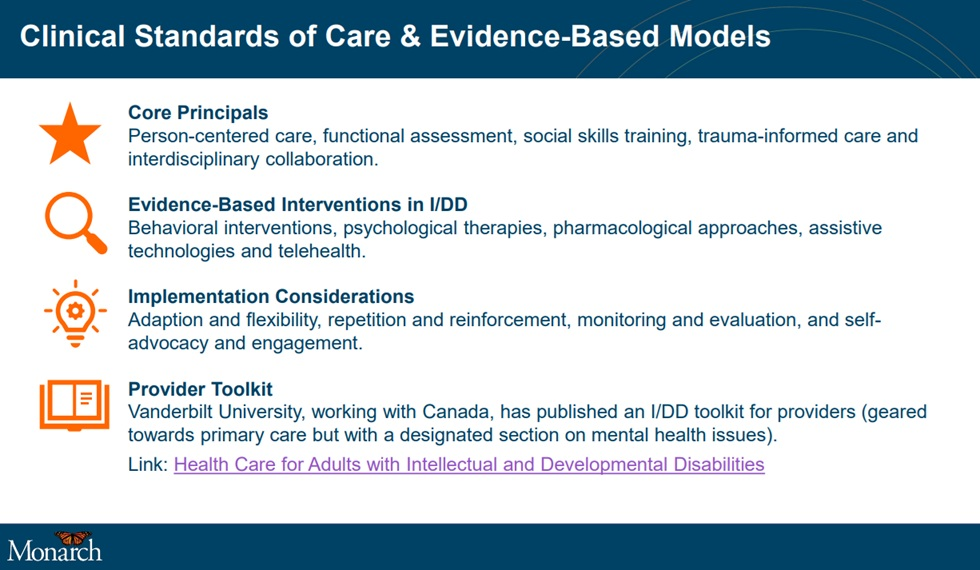
The speakers emphasized two critical steps in considering whether to develop an integrated care model for a specialty population. One is understanding consumer demand and utilization in the market. The other is assessing an organization’s own ability to stand up an integrated model.
One starting point for organizations weighing an integrated model is an audit of the existing the prevalence of co-occurring conditions in their current consumer population. National data indicate the prevalence is already there; the question is whether coding captures it. This includes tracking polypharmacy and crisis utilization as board-level operational metrics rather than clinical details.
If the demand for enhanced services is there, the executive needs to assess whether their organization has the clinical depth to take on complex cases directly or whether partnership is a faster route. Monarch’s own approach is a federated structure in which independent organizations pool clinical expertise, back-office support, and buying power while continuing to operate independently.
The session’s central argument was that integrated care for this population is shifting from one-time grant funding and pilots to a baseline requirement for provider organizations. This means creating capacity or partnership to build out the necessary staffing, technology, contracting, and culture to shift the model. According to Dr. Terhune, this shift is better for consumers. As she put it: “Find ways to keep people out of the hospital. It’s the worst thing that can happen to someone with I/DD.”