By Monica E. Oss, Chief Executive Officer, OPEN MINDS
Medicare’s Long-term Enhanced ACO Design (LEAD) Model is set to launch on January 1, 2027 – New CMS LEAD Model Aims To Expand Access To Accountable Care, Improve Health Outcomes. This model is replacing the Medicare REACH ACO model – Realizing Equity, Access and Community Health – which sunsets on December 31 of this year.
This is a key strategy to meeting the CMS goal of having all Medicare enrollees in some type of managed care or accountable care by 2023. Currently, of the 70 million Medicare beneficiaries, 35.9 million are in Medicare Advantage plans and 14.3 million are in ACOs – either the traditional Medicare Shared Savings Program (MSSP) model or the current REACH ACO. That leaves almost 20 million in traditional fee-for-service without any connection to accountable care.
Historically, CMS ACO models have demonstrated the potential to enhance care and reduce costs through fewer hospitalizations, reduced emergency department visits, and lowered levels of avoidable high-cost care. However, earlier models were not designed to serve smaller, rural, or independent provider organizations well, or support those tending to higher-need populations. With the LEAD ACO model, CMS aims to change that.
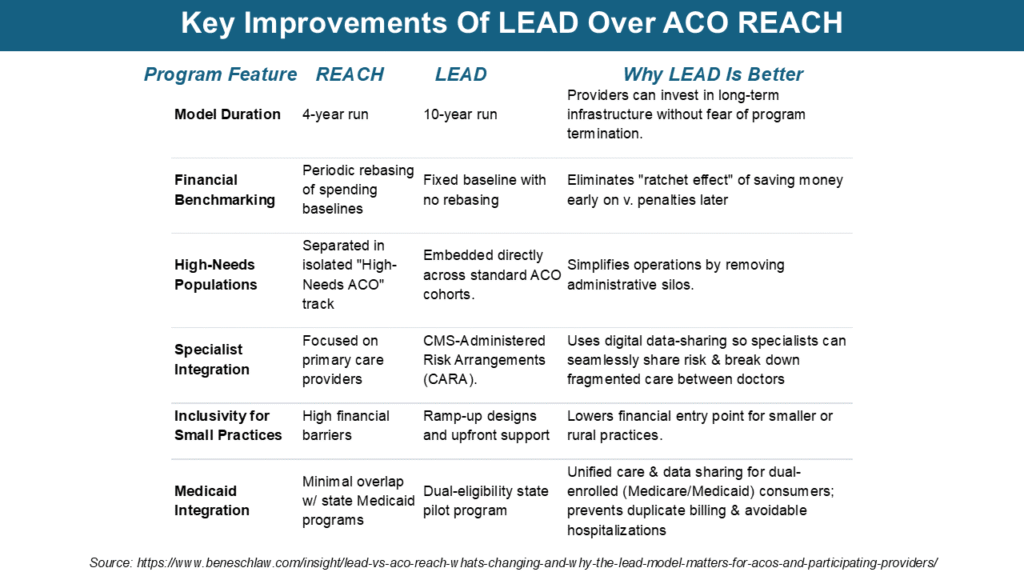
One of the changes is lower upfront cash requirements. The model also has a longer runway – LEAD’s 10 years versus REACH’s four years – that allows more time for provider organizations to invest in infrastructure. REACH’s four-year demo had a historical benchmark rebased over time, which ended in a full transition to a regional “rate book” by the final year of the program. But LEAD’s 10-year program allows ACOs to not lose early savings to the benchmark cuts that foster long-term care transformation; the second half of the program’s decade may transition to rate book only after years of stability. Finally, provider organizations are allowed the flexibility to check in with consumers in between visits to de-escalate problems before they become health crises.
The value-based reimbursement model for LEAD is complicated. As a 10-year voluntary model running from 2027 through 2036, LEAD offers provider organizations two risk-sharing options: global (i.e., eligible to receive up to 100% of their savings and liable for up to 100% of total losses relative to their established performance benchmark) or professional (i.e., eligible to receive up to 50% of total savings and liable for up to 50% of total losses relative to their established performance year benchmark).
Most provider organization executives need to update their strategy for serving consumers with Medicare. The program covers over a quarter of all U.S. adults and is growing quickly with the aging of the U.S. population. In addition, the CMS priority of getting all Medicare provider organization reimbursements in some form of value-based reimbursement is shared by state Medicaid directors, employers, and health plan executives.