
By Monica E. Oss, Chief Executive Officer, OPEN MINDS
Looking ahead to 2027, analysts project that health plan costs are going to increase by 9%. The cost drivers of the projected increase – artificial intelligence (AI)-enabled documentation and coding tools, increased provider organization reimbursement pressure, pharmacy cost trends, behavioral health utilization, and higher out-of-network reimbursements – were the focus of our previous executive briefing, Anticipating The Tide.

The question for provider organization executive teams is, what will this cost spike mean for health plan network management and reimbursement strategy – and how will that affect their relationship with health plans? Given the fact that the majority of health care reimbursements in the United States is now through health plans, this is an important strategic question. To provide some insights, I turned to my OPEN MINDS colleagues Paul Duck, Chief Strategy Officer, and Margaret Mays, Ph.D., Senior Associate. They identified the three effects these cost pressures will likely have on provider/health plan partnerships – changes in network management philosophy, focused programming on high-cost consumers, and investments in payment integrity and claims audit initiatives.
The most fundamental change that provider organization executives are likely to see from health plans in the year ahead is a fundamental change in network management and reimbursement strategy, according to Mr. Duck. One of the most immediate likely changes is health plan offerings with narrower networks – which give health plans more leverage in rate negotiations, reduces administrative complexity, and steers consumers toward “preferred” provider organizations. Other network management transformations could include broader adoption of centers of excellence and selective referral arrangements.
The implication for provider organizations will be the need to compete for these “partner” relationship as networks contract. “Being in-network won’t be enough: The opportunity to become preferred partners versus contracted providers requires a clear value proposition based on outcomes, access, consumer experience, cost impact, and the ability to manage higher-acuity populations. Health plans are looking for provider organizations that can navigate access, acuity, outcomes, and total cost of care as strategies change. Those that can document impact on ED diversion, inpatient avoidance, medication adherence, and total medical expense will have a much stronger payer value proposition,” Mr. Duck explained. “The question executives ought to ask is simple: If a health plan reduces its network, is my organization essential enough to remain?”
Another area where health plans are likely to focus is on reducing the total cost of care of high-cost consumers. These consumers will likely fall into a couple cohorts – consumers with co-occurring chronic conditions (both behavioral and medical) and consumers with conditions requiring emerging (and high-cost) therapies.
The providers serving both of these consumer cohorts are seeing an increased use in performance-based and value-based reimbursement arrangements. For high-cost consumer cohorts, risk-based contracting with specialty integrated care programs for both behavioral and medical conditions is emerging.
For high-cost therapies, particularly new expensive medications, performance-based pharmacy payment models are expanding. For example, the manufacturer of a cholesterol-lowering drug with a list price of over $14,000 per year developed a health plan contract that provided rebates if predicted reductions in LDL cholesterol did not occur.
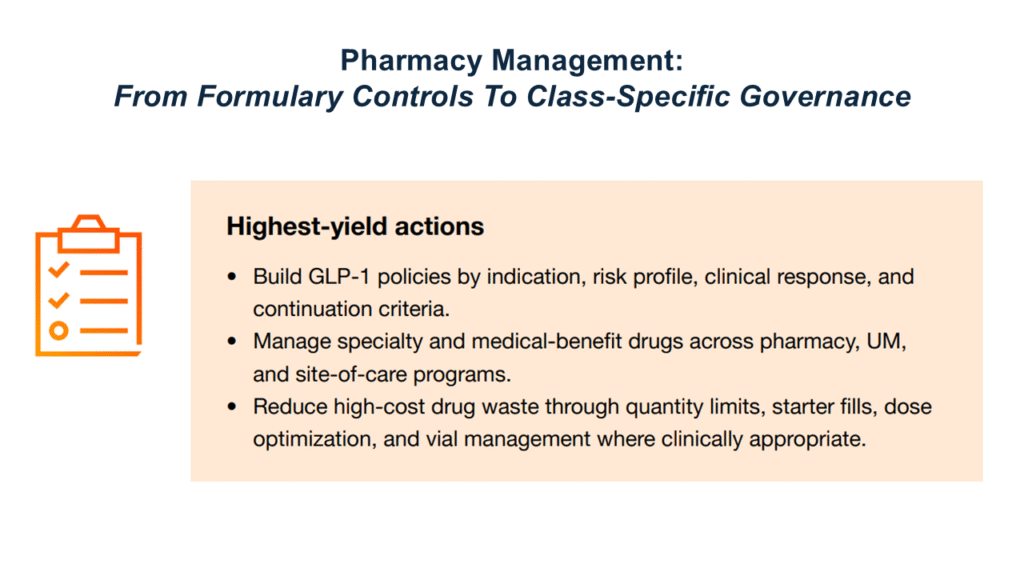
Outside of financial alignment with provider organizations, health plans will likely also increase their use of concurrent review, medical necessity reviews, documentation requirements, evidence-based care mandates, and strengthening site-of-service optimization, according to Dr. Mays.
“As health plans re-evaluate their models based on utilization and claims data, we are likely to see changes like requiring step therapy prior to approval of a high-cost drug or more frequent prior authorizations with proof of outcomes. In addition, network provider organizations and vendors may see the coverage for some programs discontinued, especially those that don’t produce the outcomes and cost savings as expected,” she noted.
A third area of likely expansion is an increased health plan focus on payment integrity and claims audit initiatives. Coding tools and AI-enabled documentation will likely accelerate health plan investment in payment integrity…even as additional governance will be required. “Health plans will likely re-evaluate their payment integrity software and tools to ensure providers are paid accurately according to the plans fee schedule,” said Dr. Mays.
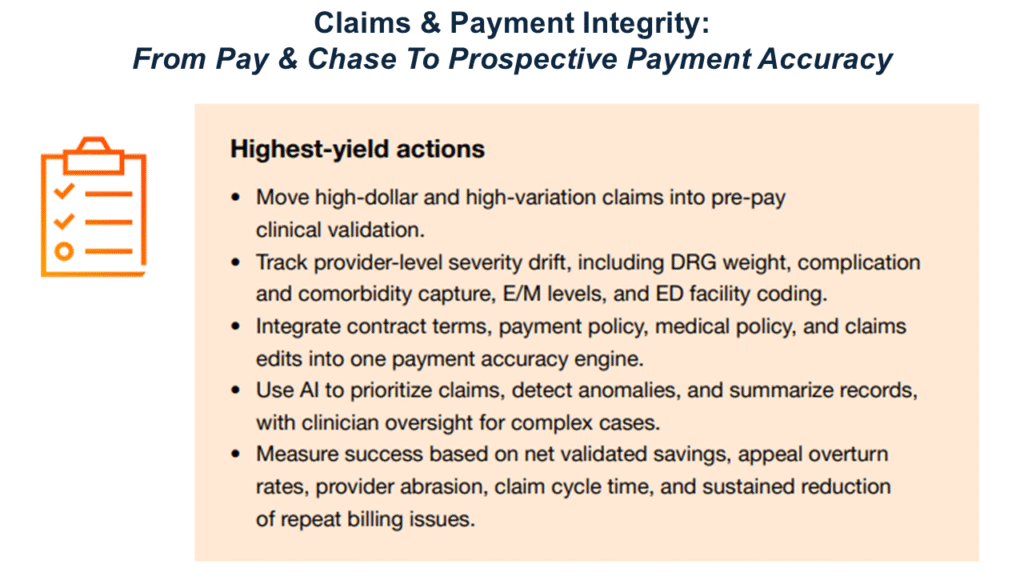
This said, she noted that if provider organizations are using technology to capture greater clinical complexity, health plans will employ their own to identify coding intensity, severity drift, compliance issues, and claim patterns that increase cost without evidence of increased clinical acuity. This does not necessarily mean more denials; rather, the best payment integrity strategies are designed to improve accuracy before payment is made. But documentation, coding compliance, internal audit processes, and clinical justification will become increasingly important for provider organizations
The implication here for provider organizations is the need for a “rock solid” revenue cycle management program that anticipates frequent audits. Because for health systems, this is not simply a reimbursement challenge but rather the impetus to become more proactive, data-driven, and aggressive in managing the cost and performance of their provider networks. The provider organizations that succeed will not necessarily be those with the largest footprint or longest history; they will be the ones that can consistently demonstrate measurable outcomes, lower total cost of care, stronger consumer experience, dependable revenue cycle management, and operational excellence.
The need for an enhanced health plan partnership model is the theme underscored by both of my colleagues. As Mr. Duck noted, “In the years ahead, every provider executive should assume that every contract, network decision, and reimbursement discussion will come down to one question: Can this organization clearly demonstrate value? Provider organizations that can answer that question with confidence – and with data – will be the ones best positioned to survive.”