
By Monica E. Oss, Chief Executive Officer, OPEN MINDS
The challenges of transitioning consumers with opioid use disorder (OUD) from emergency care to ongoing treatment have been well documented. Hospital emergency departments have become one of the primary entry points into addiction treatment, with nearly 790,000 annual opioid-related hospital stays nationwide according to a new analysis – Trends In Hospital Stays Associated With Alcohol, Opioid, And Stimulant Use. Yet many consumers never successfully connect to ongoing treatment after discharge.
What happens after discharge remains the critical challenge. Another recent study – Initiation And Retention Of Opioid Use Disorder Treatment Medication After Emergency Department Discharge Among South Carolina Medicaid Enrollees – found that just 7.6% of individuals with an opioid-related emergency department visit initiated medication for opioid use disorder (MOUD) within 30 days of discharge. Among those who did begin treatment, only 32.2% remained on medication for 90 days.
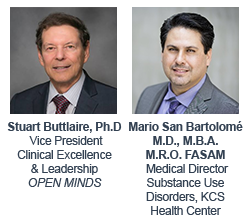
This gap in the use of best practice treatment for OUD is a significant issue for consumers and payer alike. The question for provider organization executives is how to close those gaps and assure consumer access to the most effective treatment models. That was the focus of a recent RECADEMY webinar, Breaking Through Adoption Barriers In Evidence-Based SUD Treatment: How KCS Health Center Expanded From Basic Access To A Fully Integrated “SUD 2.0” Model, with Mario San Bartolomé, M.D., Medical Director of Substance Use Disorders at KCS Health Center, and my colleague Stuart Buttlaire, Ph.D., OPEN MINDS Vice President of Clinical Excellence & Leadership. Their message was that improving long-term consumer recovery – with effective care models that integrated behavioral health and medications – requires provider organizations to redesign treatment for consumers and continuously adapt those services as consumer needs evolve.
KCS Health Center is a federally qualified health center (FQHC) serving high-risk populations throughout Orange County, California. Originally established as Korean Community Services, the organization has expanded into a broader provider of primary care, behavioral health, and substance use disorder treatment. Today, KCS combines rapid-access treatment, integrated behavioral health, and wraparound care for individuals with complex medical, behavioral health, social, and justice-involved needs.
For Dr. San Bartolomé and the KCS team, the first phase of redesign focused on expanding their OUD treatment program to include same-day access, telehealth, integrated behavioral health, and medications for opioid use disorder (MOUD). “We had already exceeded what a typical clinic could imagine doing,” he said. “But we knew we could do better.” The next question became, “What are we still missing?” As a result, KCS expanded into what it calls “SUD 2.0” by adding peer support, psychoeducation, contingency management, family engagement, employment assistance, lead care managers, and structured recovery pathways to create a comprehensive system of care.
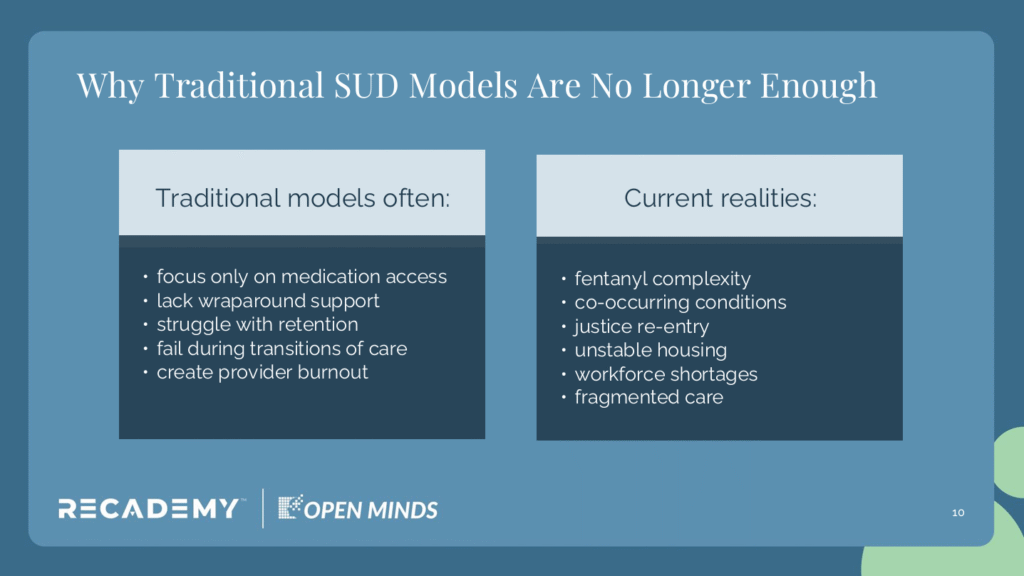
Dr. San Bartolomé emphasized that the evolution required more than expanding services. It required redesigning the organization itself. He outlined three priorities for executive teams: start service redesign with the consumer in mind; redesign the workforce to consistently deliver evidence-based care; and create the ability to shift the operating model as consumer needs evolve.
The first – service redesign with the consumer in mind – is a shift in mindset. It places consumer needs and preferences ahead of the current operating model for services. Dr. San Bartolomé explained that for KCS, the next challenge was determining what consumers needed after entering treatment. Rather than relying on standardized care plans, the organization created a wraparound system of care with expanded peer support, psychoeducation, contingency management, lead care managers, family engagement, employment assistance, and structured recovery pathways. “We got the medicine, we get the diagnosis, now what else?” said Dr. San Bartolomé. “What we wanted to avoid…is a one-size-fits-all. We really wanted to have a process that immediately reflects what that individual needs.”
Redesigning the treatment model also requires redesigning the operating model of services. Dr. San Bartolomé noted that evidence-based SUD treatment cannot depend on one clinical champion. Organizations need physicians, therapists, peers, care managers, front office staff, and executive leadership all working within the same clinical model. That means investing in education, creating multiple champions throughout the organization, and giving staff the confidence to adopt new approaches while leadership removes operational barriers to implementation. “It can’t be just one person,” said Dr. San Bartolomé. “It needs to be flat. There needs to be multiple points of ownership, starting with leadership.”
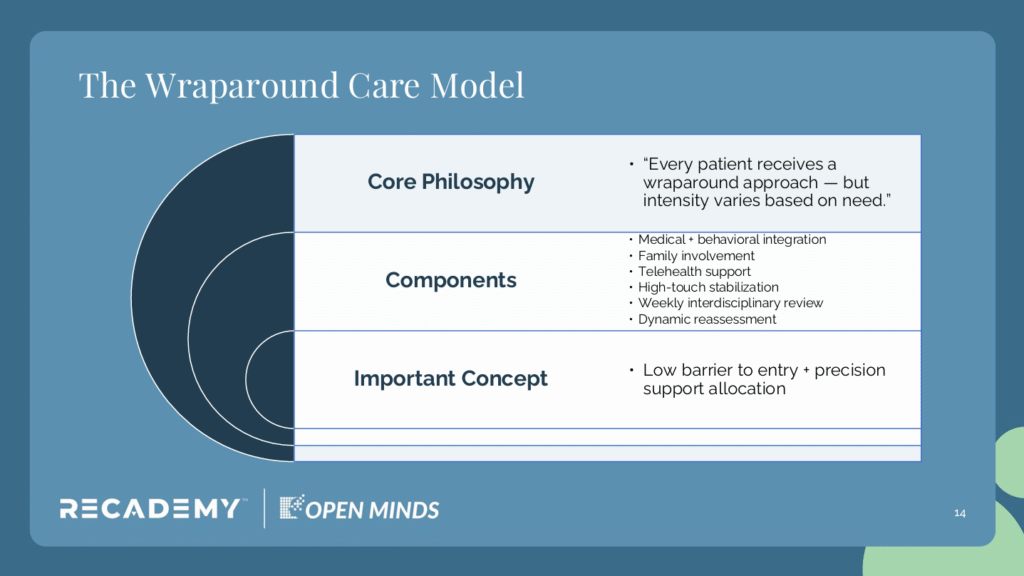
Finally, executives need to create operating systems that continuously evolve with consumer needs. Dr. San Bartolomé encouraged leaders to begin with the recovery outcome they want consumers to achieve and then work backward to identify gaps in staffing, partnerships, workflows, and community supports. As consumer needs change, organizations should continually expand services, strengthen community partnerships, and adjust care models rather than assuming the current approach will work as needs change.
“You have to start with the end in mind,” said Dr. San Bartolomé. “Then you need to work backwards and figure out where the gaps are with resources that will enable us to get that person to that point.”
The speakers emphasized that improving access alone is no longer enough to improve recovery outcomes. Sustainable transformation requires leadership commitment to continuous improvement. As Dr. Buttlaire concluded, “Transformation is not simply about adopting a new clinical model or implementing a new workflow. It’s about leadership, engagement, and accountability – about really creating the organizational environment where evidence-based care can actually be delivered consistently and sustainably over time.”