
By Rick Rowley, Senior Associate, OPEN MINDS
Most behavioral health and human service organizations generating less than $60 million in revenue are preparing for a value-based reimbursement (VBR) contract that does not exist in the form they expect. The disconnect is that many behavioral health provider organizations prepare for the kind of VBR opportunity common in physical health care, while most behavioral health value work happens inside a contract held by another organization.
This might include a primary care provider organization that hires a behavioral health provider as part of a care coordination model. Or, it might include a federally qualified health center (FQHC) or a payvider health plan where the behavioral health services can either be built internally or purchased. In each of these cases, the behavioral health work happens, but the savings stay with the organization holding the contract – not the behavioral health provider organization delivering the services.
Here is an example of a situation where behavioral health won’t capture value payments. A primary care group or accountable care organization (ACO) is attributed the whole person and accountable for the full total cost of care. When it reduces avoidable spending, it keeps the savings. A behavioral health organization rarely holds that attribution.
Put another way, a consumer assigned to a primary care provider organization that already holds the total-cost savings cannot be paid for twice. Two structural facts follow. First, most of a high-needs member’s total cost is physical, in hospital stays and emergency visits, which a behavioral health organization does not control, so it can influence only a slice of the denominator it would be put at risk for. Second, an ACO attributes thousands of lives, so one catastrophic case averages out, while a behavioral health panel is smaller and sicker, so a single high-cost member can drive a loss.
The trap that catches most behavioral health organizations is value work that is already spoken for. Behavioral health executives need to find openings in their state that are specifically designed for them, rather than pursuing a version of value-based reimbursement (VBR) that works in physical medicine, and then enter those openings on terms they can sustain.
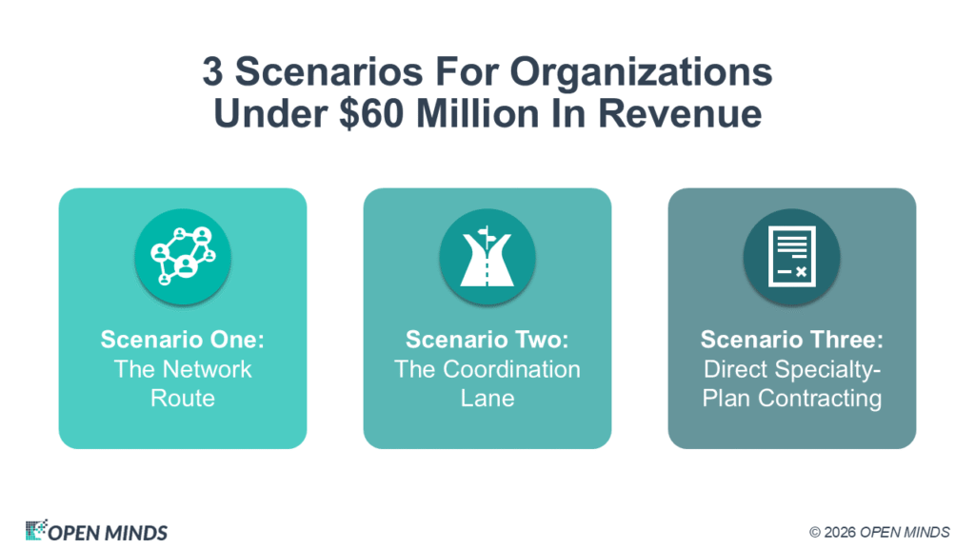
Below are three such scenarios for organizations under $60 million in revenue. Each scenario follows a different organization through a unique opportunity, reinforcing the same point: prioritize positioning before contracting.
Scenario One: The Network Route
An $18 million community mental health center in Minnesota decided it was time to pursue a value-based contract. Its leaders assumed the best move was to approach a Medicaid health plan, propose a shared-savings arrangement, and negotiate a split. Every conversation, however, stalled in the same place.
- The center’s consumers were attributed to primary care groups that already held the total cost savings, so there was nothing left to share.
- The center could influence only a slice of a member’s total spending, most of which was physical and ran through hospitals it did not control.
- The center’s panel was small and high in acuity, which meant a single catastrophic case could erase a year of results.
None of these factors meant that Minnesota had no VBR opportunity. It meant the center had reached for the wrong one. Minnesota is one of roughly a dozen states where a behavioral-health-owned network operates, an independent practice association or clinically integrated network that holds the value contract and the data and contracting infrastructure that no single small organization could build on its own and then distributes the work and the dollars to its members. That network, not the center standing alone, is what a health plan can contract with.
In response, the center changed its objective. Instead of negotiating a contract it was too small to hold, it applied to join the network. The network had already pooled enough attributed lives to make the risk math stable, and it carried the reporting systems the plan required. The center’s job narrowed to what it could actually deliver – a defensible cost per episode, one outcome it could stand behind, and the clinical results that earned its share of the pool.
The lesson this scenario reinforces is about scale and sequence. A provider organization that is too small to negotiate directly with a payer can access VBR through a joint-contracting vehicle. The first strategic question is not what split to negotiate, but whether that vehicle already exists in the state. Where a network exists, the move is to join it and contribute value the pool can measure. Where one does not, an organization can help assemble one or wait for an operator to build it, which is a multi-year effort and a very different plan than signing a contract this year.
Scenario Two: The Coordination Lane
A $12 million behavioral health provider organization in Oklahoma went looking for a value-based contract and found that the two openings it had read about were not there – no risk-bearing specialty plan contracted behavioral health provider organizations in the state and no provider-owned network had formed to pool small organizations into contracting scale. Instead, what Oklahoma had built was a coordination lane, a per-member fee that the state pays to coordinate its highest-need members, carried out in Oklahoma through the certified community behavioral health clinic (CCBHC) prospective payment system.
At first this looked like a “consolation prize” because the coordination lane is not insurance risk, and it is not really value-based reimbursement. It pays a rate to manage a population, not a share of the savings that management produces. The provider organization’s leaders had to decide whether this opportunity, which was not a final VBR destination, was still worth taking.
After financial modeling they decided to move forward. This opportunity pays for the same work that a true VBR contract later demands – receiving and acting on member data, coordinating care for a vulnerable and high-need population, measuring outcomes, and reporting on a schedule someone else sets. In other words, the per-member payment funded exactly the “muscle” the organization would need before it could carry risk, and it did so while the stakes were low and no downside was in play.
The provider organization used the lane to build its data capability and its care coordination abilities and to put itself in position for a future risk-bearing opening when it appears in the state or a network begins to form.
One caution shaped the plan. The older Section 2703 health home service is eroding – eight states have ended theirs, even as the CCBHC prospective payment continues to grow and become more established. The type of vehicle a state operates and its current trend determine whether the lane provides a stable foundation for development.
The lesson the scenario reinforces is to name the opening for what it is. The coordination lane is an on-ramp, not the VBR highway. An organization that builds capability is positioning well. An organization that takes it believing it has arrived at VBR is mistaken.
Scenario Three: Direct Specialty-Plan Contracting
A $40 million community behavioral health organization in North Carolina, with a caseload weighted toward the seriously and persistently ill, faced the opening the other two scenarios were building toward. North Carolina runs a Tailored Plan, a specialty plan operated by a local management entity (LME) that holds the serious and complex population and contracts behavioral health providers directly.
This is a genuine value-based opportunity, and it works at this size for a specific reason – the state defines the population, attributes it to behavioral health rather than to primary care, and sets and oversees the rate. The attribution problem that stops a network-less provider organization does not apply, because the state has already handed the population to the behavioral health system.
The organization started by counting, not contracting. “Serious and complex” in this case is a payer category, narrower than the roster of everyone who carries a serious diagnosis. It confirmed how many of its consumers actually met the plan’s eligibility criteria, which include the qualifying conditions and the required intensity of service or formal determination, before it made any decisions.
Then it got to “the table” the right way. It credentialed into the specialty plan’s network first, worked with the plan’s value-based care team (rather than “provider relations”), and led with the plan’s own cost problem for a cohort it could name and back with outcomes. North Carolina’s plans move provider organizations up a value ladder, from reporting to shared savings to shared risk, so the organization entered where most states sit today – on upside and performance terms – and treated downside as something to prepare for rather than sign into.
Before it signed, it did the arithmetic. It ran the “attribution haircut,” confirmed it could reach the panel-size floor that keeps one catastrophic case from swamping the result, and ran the bad-year test to ensure the worst-capped settlement fit inside the “unrestricted reserve after operating” runway. Where any downside applied, it required the guardrails in writing – a minimum savings or loss rate, a corridor cap, high-cost case truncation, an individual stop-loss for the single catastrophic member, and a phased structure that kept year one upside-only. It also built the data capability and met the clinical bar before the contract, not after.
The lessons the scenario reinforces are to find the opening your state built, enter it on the upside terms offered now, build the data and the competencies while the stakes are low, and hold the line on reserves and guardrails before you take the downside risk.
The Strategic Takeaway
In these scenarios, there were three organizations, three states, and three different value opportunities. None of the organizations started by negotiating a split. Each started by finding what its state had actually built, then entered on terms it could survive. Executives should use these scenarios to pressure-test their own VBR strategy.
Appendix: A 51-State Map Of Direct Specialty-Plan, Network & Care Coordination Contracting Opportunities
| State | Opening 1: Specialty Plan | Opening 2: Network | Opening 3: Care Lane |
| Alabama | No (FFS) | None | CCBHC |
| Alaska | ASO only | None | CCBHC |
| Arizona | Partial: RBHA SMI plan | Active (operator) | No |
| Arkansas | Yes: PASSE | None | No |
| California | Yes: County Mental Health Plans | Forming | No |
| Colorado | Partial: RAE behavioral health | Forming | CCBHC |
| Connecticut | ASO only | None | Health Home |
| Delaware | No | None | No |
| District of Columbia | No | None | Health Home |
| Florida | Yes: SMI specialty plans | Active (operator) | No |
| Georgia | ASO only | Active (operator) | No |
| Hawaii | Yes: CCS behavioral health | None | CCBHC |
| Idaho | Yes: Idaho Behavioral Health Plan | Forming | Health Home |
| Illinois | No | Active (provider-owned) | CCBHC |
| Indiana | No | Active (operator) | CCBHC |
| Iowa | No | None | Health Home, CCBHC |
| Kansas | No | Forming | Health Home, CCBHC |
| Kentucky | No | Forming | CCBHC |
| Louisiana | Partial: CSoC (youth) | Forming | CCBHC |
| Maine | No (FFS) | None | Health Home, CCBHC |
| Maryland | ASO only | None | Health Home, CCBHC |
| Massachusetts | Yes: MBHP (PIHP) | None | Community Partner |
| Michigan | Yes: PIHP | Forming | Health Home, CCBHC |
| Minnesota | No | Active (provider-owned) | Health Home, CCBHC |
| Mississippi | No | None | CCBHC |
| Missouri | No | Active (provider-owned) | Health Home, CCBHC |
| Montana | No (FFS) | None | CCBHC |
| Nebraska | No | None | No |
| Nevada | No | Forming | No |
| New Hampshire | No | None | CCBHC |
| New Jersey | Partial (in transition) | Forming | Health Home, CCBHC |
| New Mexico | No | Forming | Health Home, CCBHC |
| New York | Yes: HARP | Active (provider-owned) | Health Home, CCBHC |
| North Carolina | Yes: Tailored Plan (LME-MCO) | Active (operator) | Health Home, Tailored Care Mgmt |
| North Dakota | No (FFS) | None | CCBHC |
| Ohio | Partial: OhioRISE (youth) | Active (operator) | No |
| Oklahoma | No | None | CCBHC |
| Oregon | No | Active (provider-owned) | CCBHC |
| Pennsylvania | Yes: HealthChoices BH | None | No |
| Rhode Island | No | None | Health Home, CCBHC |
| South Carolina | No | None | No |
| South Dakota | No (FFS) | None | Health Home |
| Tennessee | No | Forming | Health Home |
| Texas | No | Forming | No |
| Utah | Yes: PMHP | Forming | No |
| Vermont | Yes: DMH case rate | None | Health Home, CCBHC |
| Virginia | ASO only | Forming | No |
| Washington | ASO only | Active (provider-owned) | Health Home, CCBHC |
| West Virginia | Partial: youth only | Forming | CCBHC |
| Wisconsin | No | Forming | Health Home |
| Wyoming | No | None | No |
Counts: a specialty plan for the serious and complex in 18 states (12 full, 6 partial); a behavioral-health-owned network active in 12 and forming in 16; a care-coordination lane in 36. Twenty states offer two or more. Seven offer none today (Delaware, Nebraska, Nevada, South Carolina, Texas, Virginia, Wyoming), of which four have no signal at all (Delaware, Nebraska, South Carolina, Wyoming).