
By Monica E. Oss, Chief Executive Officer, OPEN MINDS
Trauma is not rare – over 70% of people report having experienced a traumatic event. But not all trauma results in post-traumatic stress disorder (PTSD), which has a lifetime prevalence of 6.8%.
In addition to PTSD, trauma exposure can increase the likelihood of behavioral health conditions like depression, anxiety, and substance use disorders. And research has shown that exposure to trauma also increases physical health problems like asthma, hypertension, and sinusitis.
To address these issues, there are a growing number of approaches to trauma-informed care (TIC). These approaches have been shown to improve the outcomes of treatment for substance abuse, depression, anxiety, and PTSD (see Feasibility And Outcomes Of A Trauma-Informed Model Of Care In Residential Treatment For Substance Use).
But despite the evidence, TIC is not a common practice. The reasons are varied and include time constraints, lack of training, and concerns about further traumatizing consumers, according to recent research – Internal Medicine Residents’ Challenges In Trauma-Informed Care And Impact On Patient Care: A Multiple-Methods Study.
This survey of physicians found that 80% had a favorable view of using TIC, but 42% reported low competence in using the approach. And knowledge tests confirmed that. Less than half (36%) correctly recognized that the severity of an injury or illness does not necessarily predict the intensity of a consumer’s traumatic stress reaction. Only 26% recognized that many consumers experiencing serious illness or injury will cope well on their own, and just over half (53%) knew signs and symptoms of traumatic stress in ill or injured patients. Notably, 58% incorrectly believed that most consumers with life-threatening illnesses or injuries will develop significant post-traumatic stress response or disorder.

This raises a question for health and human service executives – how can they successfully adopt trauma-informed models and make them a part of daily operations and organizational culture? We got an answer to that in the recent OPEN MINDS Executive Roundtable, A Blueprint For Sustained Trauma-Informed Care: The Hillsides & Klingberg Family Centers Case Study, featuring Samira Vishria, Senior Director of Professional Development at Hillsides, and Patricia Wilcox, Vice President of Strategic Development at Klingberg Family Centers. Hillsides, headquartered in Pasadena, California, is a $50 million non-profit organization that provides behavioral health residential and day treatment and community-based mental health services for youth and families. It serves 14,000 consumers annually and employs 400 staff across Los Angeles County, Orange County, San Bernardino County, and Riverside County.
Headquartered in New Britain, Connecticut, Klingberg is a non-profit that provides trauma-informed services for children and families, offering residential, special education, foster care, and community programs. It also operates the Traumatic Stress Institute, a professional training division that helps organizations adopt trauma-informed care. Klingberg serves over 3,000 people annually and employs approximately 300 staff.
In 2013, Hillsides’ executive team and staff had a number of challenges thrust at them – the closure of their foster care and adoptions programs; an increase in the number of consumers with severe needs; plus requirements to reduce lengths of stay all while handling larger caseloads. As a result, the Hillsides’ staff began experiencing heightened levels of burnout in addition to vicarious trauma. To address this, the executive team started the search for an approach that could help staff understand trauma, stay connected to the work, while sustaining trauma-informed care models for their consumers.
This is when the Hillsides executive team made the decision to adopt the Risking Connection model of Klingberg’s Traumatic Stress Institute – a trauma-informed system that trains all staff in an organization to understand and respond to trauma effectively. The model focuses on relationship building, adopting a shared language around trauma, and addressing vicarious trauma among staff. The model uses a “train-the-trainer” approach to develop internal experts who can continuously train their workforce and keep the model embedded in an organization’s culture.
Adoption of this new model required three primary actions for Hillsides. First, it required training in the model for all staff – with additional self-care training available. Second, it created a monthly leadership academy to discuss TIC management challenges and embedded TIC discussions in routine staff meetings. And third, it created “safe channels” for staff feedback and discussions about stress including an anonymous employee survey to measure progress and watch for “slippage” away from the model.
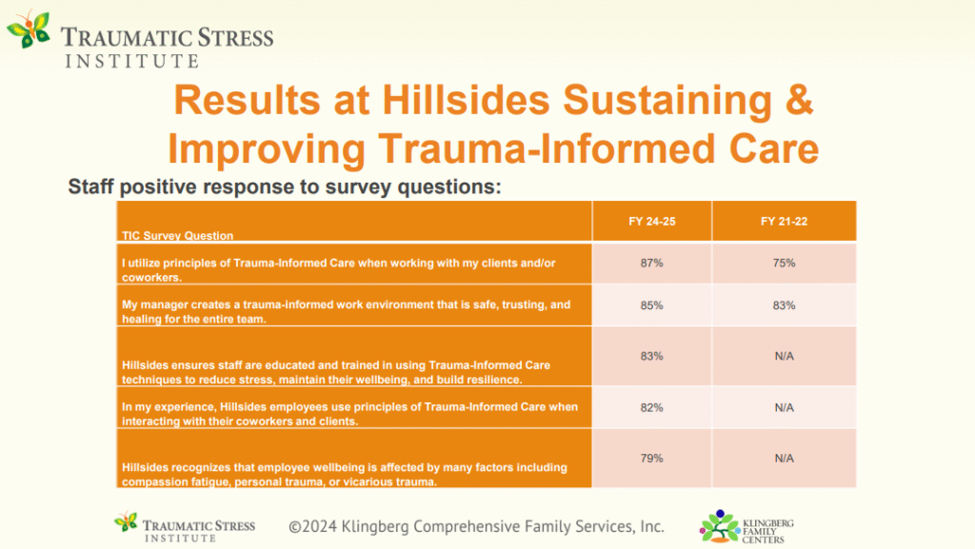
As a result of this model, Hillsides’ use of TIC in both clinical work and the organization’s overall culture grew stronger. More staff reported using TIC principles (87% in 2025 vs. 75% in 2022), and the majority of staff concurred that Hillsides now has a trauma-informed work environment (85%), uses TIC principles for both consumers and staff (82%), and recognizes the importance of compassion fatigue, personal trauma, or vicarious trauma (79%).
The executives offered two pieces of advice for executives – invest in staff engagement and training and manage to the fidelity of the TIC model. First, executives need to integrate the new trauma-informed approach into the organization’s operations. This includes investing in long-term training for all staff (not just clinicians) to prevent the model from devolving into a one-time training event with no staying power. Beyond training, the executives need to incorporate the TIC principles into hiring practices and consumer and staff feedback.
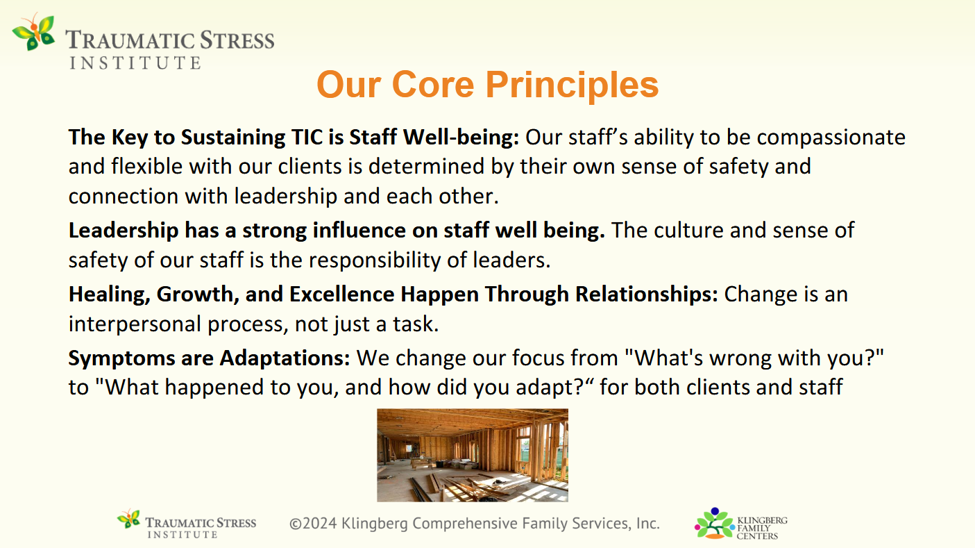
“Some organizations do a training, a one-shot deal or a couple sessions,” said Ms. Wilcox. “They train and hope. That is not enough for trauma-informed care. This is actually a pretty important change for an organization, and it affects the entire organization. It’s not just something for the clinicians. Good trauma-informed care changes everything you do, from your hiring to how you treat your employees to how you train staff.”
Fidelity to the model is also important for success. Executives can track fidelity to the model using consumer and staff surveys to track TIC use within the organization. They can also track proxy indicators that may show the model is weakening, including the use of restraints, increases in staff sick and leave time, and poor clinical outcomes.
“It’s important to know your team so that you can see when things change, when a behavior shifts, or when the tone feels different,” said Ms. Vishria. “We’re required to supervise our staff every week. Paying attention to staff wellness and to slippage happens when you are around and you see what’s happening, and you’re able to see if there are any shifts. Investment in leadership is very important because they are the ones who will be able to hold the culture that you’re trying to create.”
TIC can be a powerful tool for organizations looking for better ways to take care of both the consumers they serve and the staff who are critical to serving them. But it is an ongoing process that requires continued training, monitoring, feedback, and leadership. As Ms. Vishria put it, “If we want staff well-being, we need a healthy leadership. If you can have a strong culture, it sort of brings those people in, and then you have this space where you can support a culture that sustains it.”