
By Monica E. Oss, Chief Executive Officer, OPEN MINDS
Health care bankruptcies dropped in 2025—21% year-over-year from 2024, according to a recent analysis, Healthcare Restructuring: Trends And Outlook. But bankruptcies in the senior care sector and the hospital sector actually rose. The authors cite the primary drivers for these bankruptcies as Medicaid cuts, the move away from institutional care, pressure from payers, and the rising costs of both labor and supplies.
But not all financial distress is the same. The analysis finds that non-profit hospital financial stability is “trifurcated”—20% of hospitals with strong balance sheets are located in growing markets, the middle 65% are financially stagnant, and the bottom 15% are deteriorating.

The questions that come to mind are how did that bottom 15% go from stagnant to a deteriorating financial position and what can their executive teams do about it? Those questions were the focus of a session led by my colleague, OPEN MINDS senior associate Ken Carr, during his recent OPEN MINDS executive roundtable, From Financial Distress To Strategic Stability: A CFO Playbook. The session was part of the OPEN MINDS CFO Consortium.
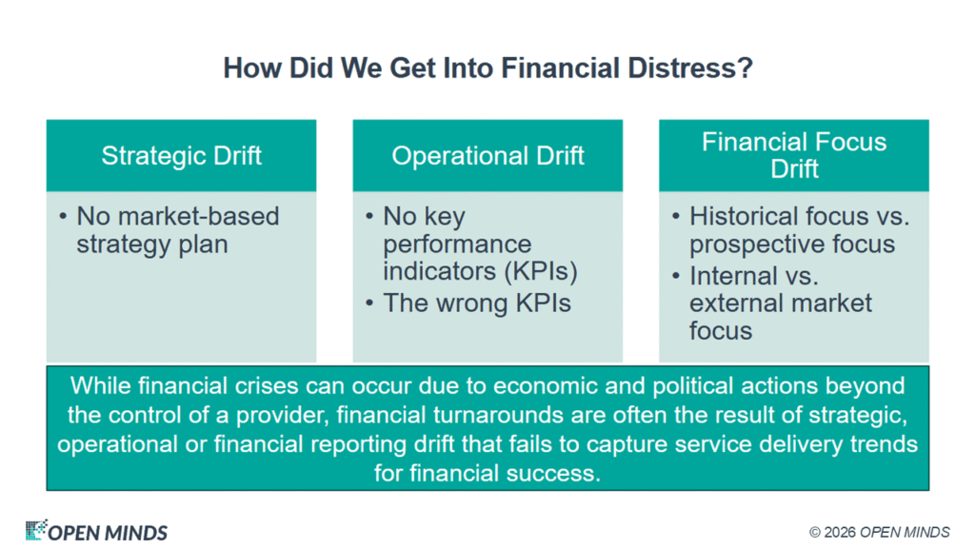
Mr. Carr explained that the “bottom 15%” didn’t arrive at a deteriorating financial position because of some cataclysmic market change. Instead, the board and the executive team allowed the organization to “drift” there. “When executive teams lose their focus on strategy, operations, and forward-looking financial management, their organizations ‘drift.’ And that drift is the precursor to financial distress—even at provider organizations that are financially healthy.
“Strategic drift is when there is no growth-oriented, scenario-based plan,” said Mr. Carr. “Operational drift is when executives lack the right key performance indicators (KPIs) and financial drift is when leaders rely on backward-looking financial statements instead of forecasting, market analysis, and cash visibility. Organizations often end up in some type of financial distress because of a drift.”
So how do board members and executive teams know they are in (or drifting toward) financial distress? It’s all about whether their financial strength to navigate both the current and future market is in decline. This includes factors like liquidity, net margin, debt, net collections, and more.
And if an organization is in (or approaching) financial distress, what is the best course of action? Mr. Carr underscored the importance of moving from traditional financial reporting to “strategic financial leadership” to improve financial sustainability. To do this, executive teams need to embrace a growth-oriented, scenario-based strategic plan; align financial performance measures and forecasts with the strategic plan’s financial model; and adopt forward-looking financial forecasting.
The foundation of this leadership approach is strategic planning with a purposeful focus on growth and an analysis of future market scenarios. “Strategic drift can happen if you don’t have a growth-oriented, sustainability-focused, or financial stability-focused, scenario-based plan. Putting that solid strategy plan in place is really critical for avoiding that strategic drift,” said Mr. Carr.
But to monitor progress on and success with strategy implementation, Mr. Carr emphasized the need for capturing the “right” data. These are financial metrics that are operationally meaningful, tied to revenue and budget expectations, and connected to the financial projections.
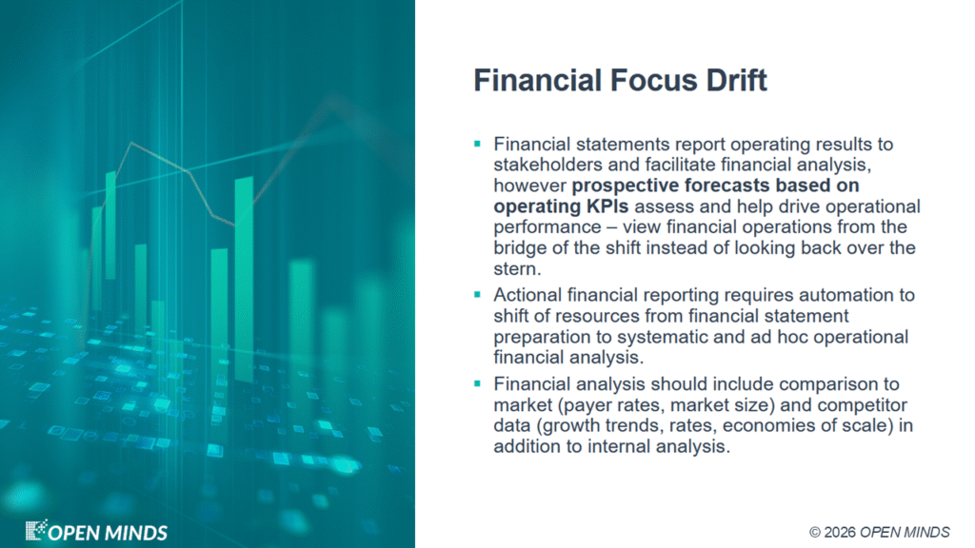
“What I have found, especially in organizations that are having some financial distress, is that the dashboard may not be capturing the right data,” said Mr. Carr. “The data that’s turned into information may be inaccurate or misaligned with the financial projections that drive organizational success.”
The final element of strategic financial leadership to reverse (or prevent) financial distress is to adopt forward-looking forecasting. This allows executive teams to identify when financial distress is likely to occur and how to navigate the path back to stability.
“The financial leader plays a key role in the executive team when there’s financial distress,” said Mr. Carr. “They need to be able to identify when we are in financial distress, how much cash we are losing based on current operations, and how certain changes can fix the situation.”
The key to resolving financial distress is to keep in mind the oft-used phrase “you can’t cut your way to prosperity.” Resolving a financial crisis involves more than just cost-cutting. Instead, it requires executive teams to build a system that sees financial distress early, understands its causes, and links the recovery plan to strategy and operations. Or as Mr. Carr put it, “You have to ask, what’s our recovery strategy, and then have an answer. Then after the crisis, create a period of recovery to strengthen the organization and build the strategy again. Then the post-recovery strategy is all about growth.”