
By Monica E. Oss, Chief Executive Officer, OPEN MINDS
Many provider organization executives are “undecided” about the wisdom of pursuing performance-based or value-based reimbursement (VBR) with downside financial risk. I’ve always been a fan—assuming the rate setting is sound and the contract is well written.
Why? Because it is the best reimbursement model for success with whole person care. It is an opportunity to share in the savings from good consumer health management. And it puts the “selected” provider organization in “first position” for controlling referrals and clinical practices in the service delivery system.
For specialty provider organizations, there are challenges to VBR contracts. One challenge is that consumers are typically ‘assigned’ by health plans to primary care provider organizations—that get a share of the cost of care savings. For specialty provider organizations that have innovative care management models for consumers with behavioral or cognitive disorders, consumers are already ‘assigned’ to a primary care entity and health plans don’t want to pay ‘twice’ for those savings—which has put a hard stop on many contracts. This is evidenced in our recent market statistics, with 81% of primary care organizations participating in VBR, compared to 65% of specialty provider organizations.
But there are emerging opportunities for specialty provider organizations to participate in behaviorally-led primary care contracts, behavioral health home contracts, outpatient service agreements, and skilled nursing facility-at-home agreements—typically capitated with additional upside/downside based on performance measures. There are also a wide variety of case rates and other types of episodic reimbursement models—such as longitudinal and time-limited addiction treatment case rates; Certified Community Behavioral Health Clinic prospective payment; residential treatment at home; hospital-discharge stabilization programs; and time-limited outpatient service agreements.
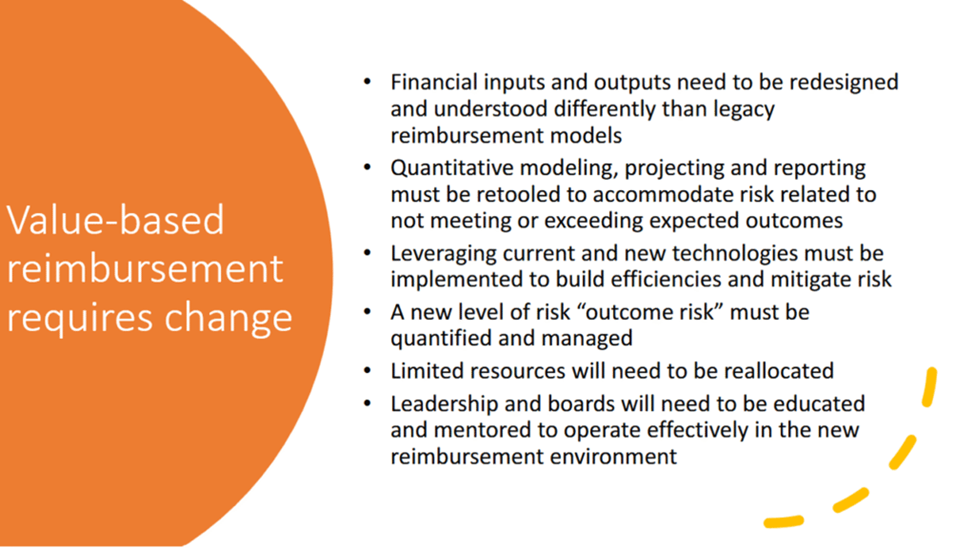
If your executive team is on the fence about pursuing some of these new forms of risk-based contracting, a recent analysis—The VBC Math That Should Change Your Mind— provides a concise summary of the key issues in succeeding with risk-based contracting. The authors identified four critical factors: model design and reimbursement rate assumptions are fundamental; the right data infrastructure and the ability to act on data are crucial; high-needs consumer management is critical; and downside risk drives both change and opportunity.
The most fundamental VBR success factor happens before the program even starts—with contract design and the related financial and performance assumptions. This includes expected metrics for consumer utilization, reimbursement rates, and system performance measurements. Understanding a VBR model’s service requirements and how performance will be defined and calculated are critical. And whatever the scenario, executive teams should create multiple-year, multiple-assumption models of how clinical and policy factors affect financial returns.
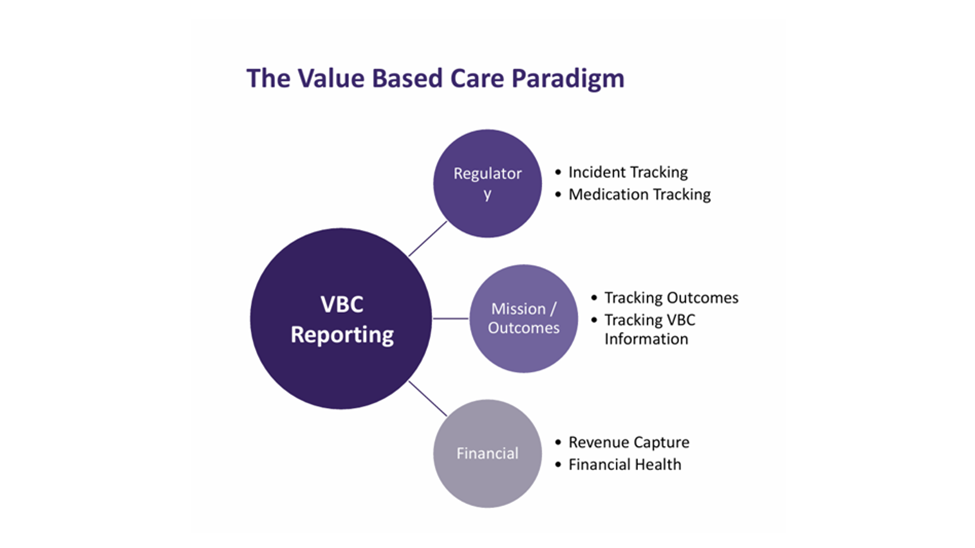
Once any risk-based contract goes live, real-time system-wide consumer data is the lifeline for success. Executive team engagement in managing population health, medical loss ratios, administrative costs, and incurred-but-not-reported claims is critical to financial success. To do this, many organizations need enhanced data infrastructure for longitudinal analysis—linking consumer and population clinical and financial data across the service continuum.
But having the right data is one organizational competency—and acting on the data is another. To succeed with population health, data needs to be reported and presented in a way that facilitates action. In short, effective population health management requires providing team members with the specifics of which consumers, what actions, and what timing.
Another key to success with any risk arrangement is identifying the consumers with high needs—specifically consumers where intervention can reduce unnecessary costs without reducing outcomes. In most health plans, 35% of total health care resources are used by the 5% of the population with a behavioral health disorder. In Medicare specifically, 5% of the population uses about 50% of resources. Specific strategies for these consumers are critical to success.
Finally, there is the pressure of downside financial risk—pressure that drives both change and opportunity. Within the bounds of the contract, provider organization management teams need to embrace innovation that is focused on population health—defined as “the process of improving clinical health outcomes of a defined group of individuals through innovative care delivery redesign supported by appropriate financial models”. To do this well requires alignment between clinical and administrative staff—for rethinking clinical models and the use of technology in service delivery.

For advice for success with risk-based contracting, I asked my colleague, OPEN MINDS Senior Associate Teresa Sands, for her perspectives. She emphasized that it was critical to first focus on the clinical side of the equation and the cost drivers that matter in managing medical loss ratios. Does a plan exist to manage crisis and emergency room episodes and the resulting inpatient stays? Are there practices in place to manage chronic conditions and address social needs? On the financial side, she emphasized that executive teams need to review the financial model and their financial reserves to ensure that they can survive the unexpected high-cost cases.
She also underscored the importance of understanding the cost of the infrastructure needed for success with risk-based contract. The largest share of the costs are in two categories—the cost of enhanced technology/reporting capabilities and the cost of additional talent. The technology costs are straightforward, but the cost of managing the contract—from care management teams and consumer care coordination to data analysts and documentation and coding support—is more subjective. Ms. Sands advised: “It is critical to assess the contract, the service delivery model, and the costs of infrastructure before committing to any risk-based arrangement. The contract may look good on paper but understanding the costs and the trends is required for it to perform reliably over time.”