
By Monica E. Oss, Chief Executive Officer, OPEN MINDS
What do managed care, whole person care, and value-based contracting have in common? They all work better when clinical leaders, not just business leaders, are shaping the decisions.
I’ve long maintained that business leaders like me are happy to make all these decisions—but the result is much better if clinical leaders are in the mix and are accountable for the business objectives. Conversely, the right set of key performance indicators assure that business leaders have to take consumer experience and clinical outcomes into account.
My colleague Stuart Buttlaire, Ph.D., OPEN MINDS vice president of clinical excellence and leadership, agrees with me. He made the case for the importance of clinical leadership in the planning process during our recent presentation, Finding Opportunity In Uncertain Times: A Leadership Framework For Success In The Midst Of Turbulence, part of the Santa Barbara CBO Coalition’s Strategic Opportunities In Challenging Times series. He discussed how clinical leadership can improve sustainability—and where organizations go wrong when those leaders are not fully integrated into strategy.
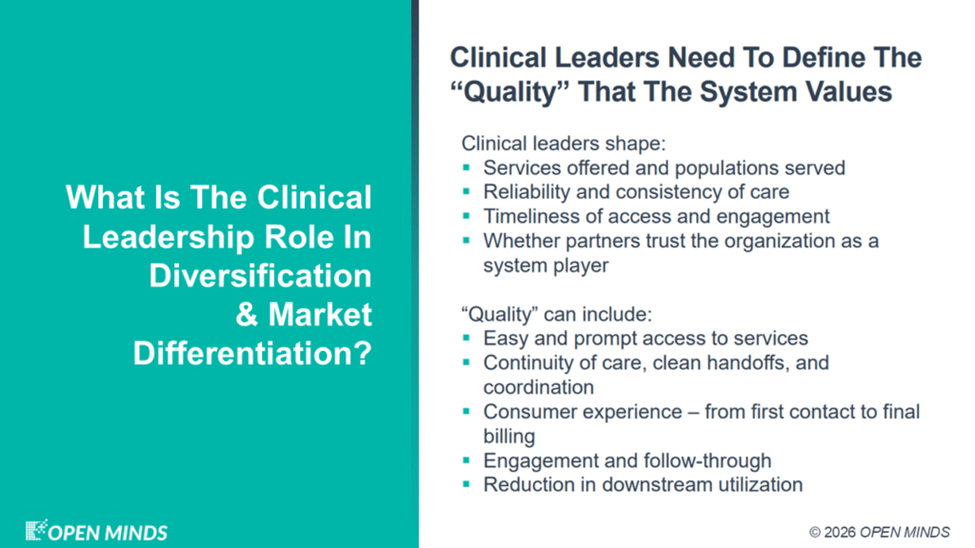
In his work with community-based organizations in California, Dr. Buttlaire observed that their financial sustainability rarely fails due to reimbursement alone. “Financial sustainability breaks down when organizations and their clinical team lack clarity on their role in the local health care system; on the populations they are uniquely positioned to serve; and on the specific clinical problems they are solving…Sustainability is not only a financial problem, but it is also a clinical leadership and strategy execution issue. Financial pressure eventually reveals whether that clinical clarity does and does not exist.”
Dr. Buttlaire’s central point is that at the core of sustainability is whether an organization is essential. And that market differentiation is largely attributed to the fundamentals of its services: the organization’s market niche and target population; consumer clinical profile and outcomes; and role in the broader system of care define their mission, their service portfolio, and their competitive advantage.
This competitive advantage can be measured by metrics like access to care/timeliness of services, care coordination/care continuity, consumer experience, reductions in emergency department utilization, and clinical outcomes. As Dr. Buttlaire noted, these are not simply operational metrics. They are central to how an organizations’ performance is assessed and whether they are a desirable partner. And they are all dependent on clinical design decisions.
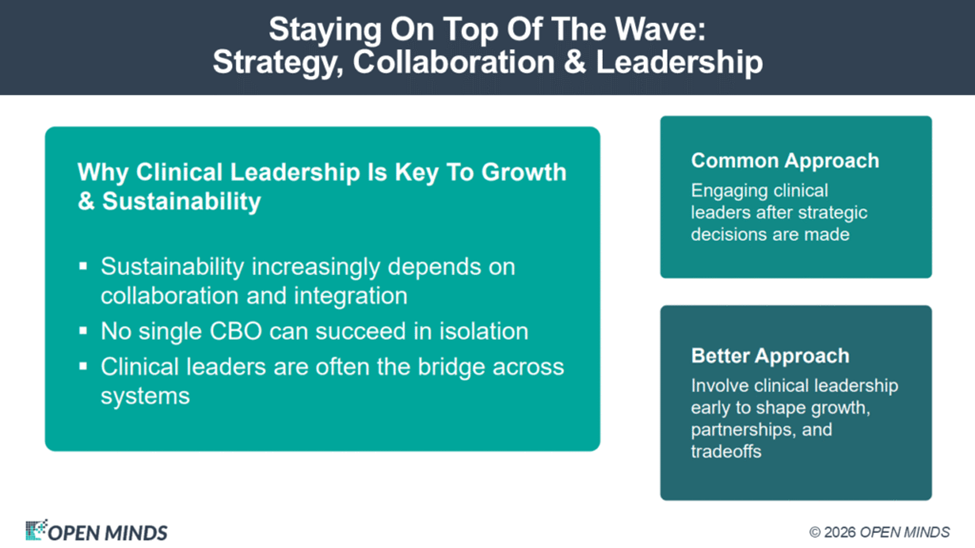
One key challenge Dr. Buttlaire identified is that sustainability increasingly depends on collaboration and integration across systems. Very few community-based organizations can succeed in isolation. And it is typically an organization’s clinical leaders who serve as the bridge between primary care, hospitals, crisis systems, social services, and regulatory entities.
For success in this very turbulent time in health and human services, Dr. Buttlaire encouraged executive teams to leverage the knowledge of their clinical leadership in planning for the future. He said, “Bringing clinical leaders in after decisions are made limits their ability to shape execution and undermines alignment. Clinical leaders do not need to become financial experts, but they do need to understand the market forces their organization faces and help define what quality means within that context.”