
By Monica E. Oss, Chief Executive Officer, OPEN MINDS
Some statistics that surprise me. What percentage of homeless consumers have health insurance? 83%. What percentage of homeless consumers report using the emergency room for their “regular place for care”? 48%.
These were some of the market data in a new study, Toward Thriving, Understanding Health And Homelessness: California Statewide Study of People Experiencing Homelessness. The data paints a picture of significant needs and delivery system gaps in services for housing insecure consumers. This includes the fact that nearly half (48%) of homeless adults are heavy users of alcohol, regular users of illicit drugs, suffer from hallucinations, or were recently hospitalization for a mental health condition.
Beyond those behavioral conditions, the most common illnesses in this population are hypertension (high blood pressure), 30%; lung disease, including chronic obstructive pulmonary disease, emphysema, or asthma, 25%; and heart disease or stroke (coronary artery disease, past heart attack or stroke, and congestive heart failure), 15%. More than one-third (34%) reported at least one limitation in activities of daily living—16% reported three or more.

But despite these high needs, services are sparse. Over the past six months, three-quarters (78%) of these consumers have spent the majority of their time in unsheltered settings (21% living in a vehicle and 57% living outdoors, or in a place not meant for human habitation), and 22% spent most of their nights sheltered.
During the same time period, more than one-third, or 37%, reported having visited an emergency department (ED) (without being admitted to the hospital) in the prior six months: 17% reported one visit, 11% reported two, and 9% reported three or more. Twenty-one percent were hospitalized for a physical health condition. And while 39% reported having a primary care provider organization, 22% indicated they were unable to get care there.
A successful model for addressing the needs of the homeless population was the focus of the recent Executive Roundtable, A Blueprint For Cross-System Homelessness Response & Behavioral Health Innovation: The Safe Options Support Program & CBC Hub Case Study, featuring Pamela Mattel, Chief Executive Officer of Coordinated Behavioral Care (CBC). She shared her experiences launching the Safe Options Support Program (SOS) in 2022, an initiative to coordinate services for homeless individuals who are living on the street.
CBC is a $121 million, 77-member nonprofit network of behavioral health and human services organizations in New York that provides behavioral health, primary care, care coordination, housing, and social care. It is organized as a member-led, clinically integrated independent practice association and health home that serves more than 150,000 individuals annually.
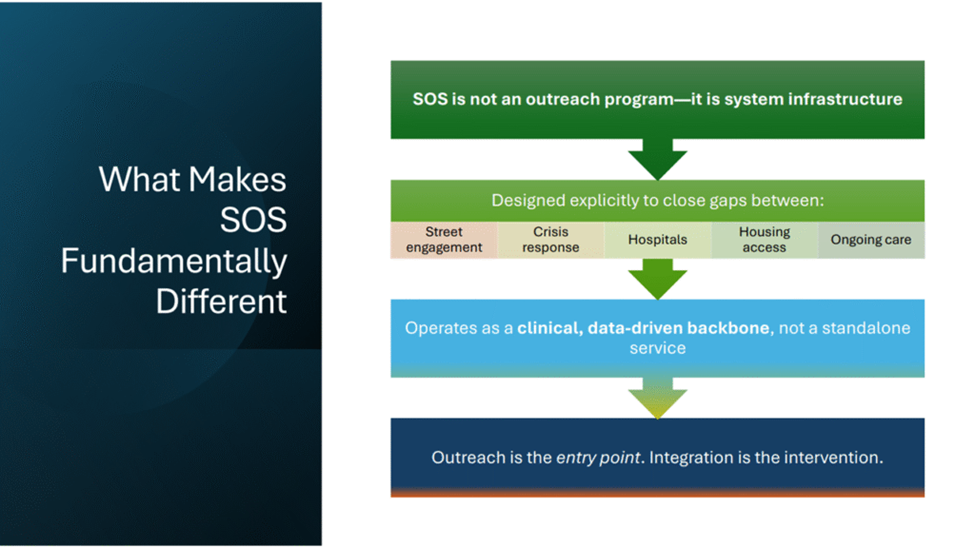
CBC’s Safe Options Support Program (SOS) is an integrated delivery system designed to close service gaps for people experiencing homelessness. At the system level, SOS is a data-driven integrated care backbone—assuring that services from crisis, to health care, to health-related social needs are delivered and coordinated. To do this, CBC has 20 multidisciplinary teams operating 24 hours a day, seven days a week. Serving adults who are homeless in public locations, who are also high-risk consumers with behavioral health conditions, and medically fragile individuals, SOS assures services are coordinated among is member network organizations, hospitals, and allied New York City services.
Over its first three years, the impact of SOS is notable. The SOS teams have moved 2,500 individuals to temporary housing and 800 individuals in permanent housing. In addition, there has been a 5% to 21% increase in homeless individuals with health insurance, depending on the population. And, post-engagement by the SOS teams, the attendance rate at behavioral health and medical appointments for the consumers they serve is 72%.
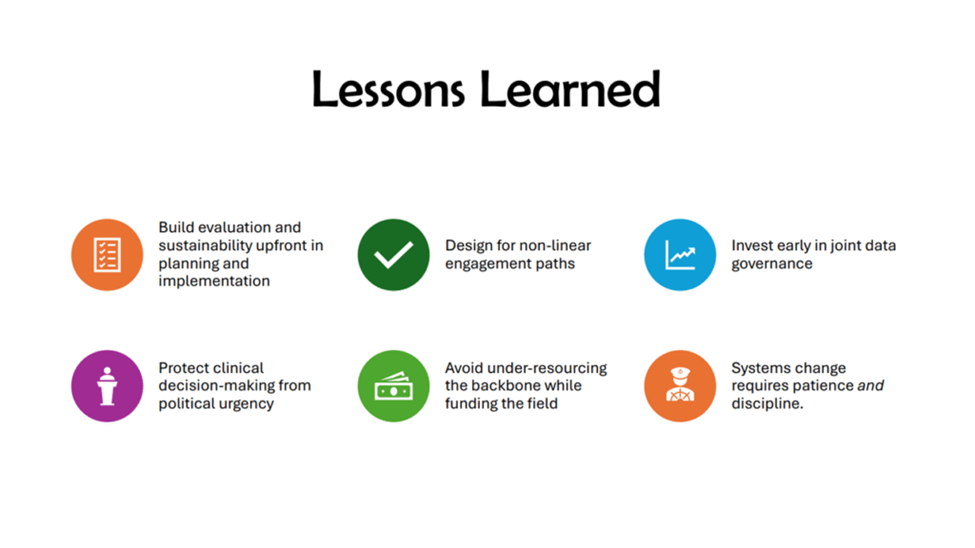
In their journey to develop a “system of services” for consumers who are homeless, Ms. Mattel shared what she learned along the way. Among those many insights, there were two that I think other executives need to note. First, the importance of investing in a flexible data-driven infrastructure for service coordination. Second, the need to create agreement among the leadership about the objectives and data that will drive decision making.
Ms. Mattel emphasized the importance of planning and budgeting for building the technology infrastructure for service coordination and data governance. She noted that data governance is critical to any coordination effort—particularly when performance is visible to the public and scrutinized by state leadership, payers, and external partners. Standardized data entry, real-time management using dashboards, and clear accountability, which are all important for great outcomes, are only achievable with a strong data governance model. The New York State Office of Mental Health, CBC, and the electronic health record vendor are involved in the data governance.
“We established a joint data governance committee…That was a watershed moment on the importance of having data as a tool, not just as a reporting function. We had to work on our data dictionary, our expectations, and the cost of electronic health record customization. Having the shared data governance brought this together in a way that was much more streamlined.”
Beyond building the infrastructure, Ms. Mattel cautioned that program leaders need to agree on their objectives and the activities to accomplish them. This is important to protect the organization from yielding to optics-driven actions that may be politically appealing in the short term but not necessarily on point with the objectives of the program.
“We have had to say no to activities that looked good to some people but didn’t resolve anything,” said Ms. Mattel. “For example, we were asked to participate in clearing encampments once. We stood firm and said no to removing people and their belongings because it was not really related to the mission of SOS. However, we understood the value of being at encampments for engagement and service provision. Politically, this continues to be framed as a visibility issue, and that frame does not align with how change happens. I have had to grapple with how our systems are optimized for optics, not outcomes.”
In the end, Ms. Mattel advised that making care coordination work requires strong working relationships grounded in trust. “To accomplish this collectively, we focus on incremental trust…The requirement to really manage all the conflict between all the different systems raised all sorts of trust issues for everyone. Trust is really the bedrock of things. It is a daily discipline for us to find pockets to build trust more.”