
By Monica E. Oss, Chief Executive Officer, OPEN MINDS
Once strictly a clinical approach, trauma-informed care (TIC) is now a pathway for improving consumer experience as well as clinical outcomes at most provider organizations. But for all the focus on the trauma-informed experience in recent years, I was surprised at an issue raised in a recent article, Why Trauma-Informed Care Must Include The Messages We Send. In an era of automated text programs, artificial intelligence (AI), and chatbots, I hadn’t thought about the automated communications that consumers and their families receive from provider organizations.
The point of the author was that many of the “personalized” automated communications that provider organizations use to contact consumers don’t recognize consumers’ lived experiences and can unintentionally recreate trauma. One example is a parent receiving an automated wellness reminder for a deceased child. Another example is a parent receiving a service satisfaction survey for a child’s recent cancer diagnosis.
From an operational perspective, this messaging is often not considered—and there is a challenge. Most provider organization executive teams have adopted automated communication in pursuit of operational efficiency, but the communications rely on fragmented data across disparate information sources. These are imperfect information sources that don’t always have real-time consumer information.
The recommendation? Management teams should develop processes to integrate “critical life events” across communication governance models. These models should adopt “harm avoidance, sentiment, and caregiver trust” as core performance indicators.

As provider organizations continue to pursue better consumer experiences and outcomes, trauma-informed service delivery will be increasingly important. We recently heard how one organization stood up a trauma-informed culture in our Executive Roundtable, Building A Trauma-Informed Culture: The Youth Home Case Study. Peggy Kelly, chief executive officer of Youth Home, shared how she adopted a TIC model across the entire organization.
Founded in 1966, Youth Home is a $17 million non-profit provider organization based in Little Rock that offers intensive residential treatment for teens ages 12 to 17. Services provided span from medical and psychiatric treatment to social services and education. Youth Home also provides outpatient services for individuals of all ages. It serves an estimated 1,700 consumers annually and employs approximately 225 employees.
Ms. Kelly described how, at one point, Youth Home was using a behavior-management model that resulted in higher restraint and seclusion rates with staff and consumer injuries. The model was also responsible for additional workers’ compensation claims, staff turnover, and longer lengths of stay. And this model limited Youth Home’s ability to differentiate itself as a “premier provider” to payers and referral sources.
To improve their performance, Ms. Kelly began shifting the organization away from their legacy model toward a fully trauma-informed organizational culture that was grounded in emotional safety, regulation, and relationship-based healing for staff and consumers. To do this, she implemented the model across the entire organization in 2018. In addition to applying the model to the consumers, the Youth Home leadership encouraged their staff to apply the model to their own personal trauma in order to regulate their emotional responses when working with Youth Home consumers. While going live with the TIC model, Youth Home also implemented the use of the Brøset Violence Checklist (BVC), which is used to predict violence in a 24-hour period.
“Our trauma-informed approach and the use of the BVC have been proven to reduce aggressive incidents by 68%,” said Ms. Kelly. “The use of this instrument helps us identify indicators that a resident will escalate. It allows us to intervene and connect with the individual to provide regulation and de-escalation to reduce restraints and seclusions.”
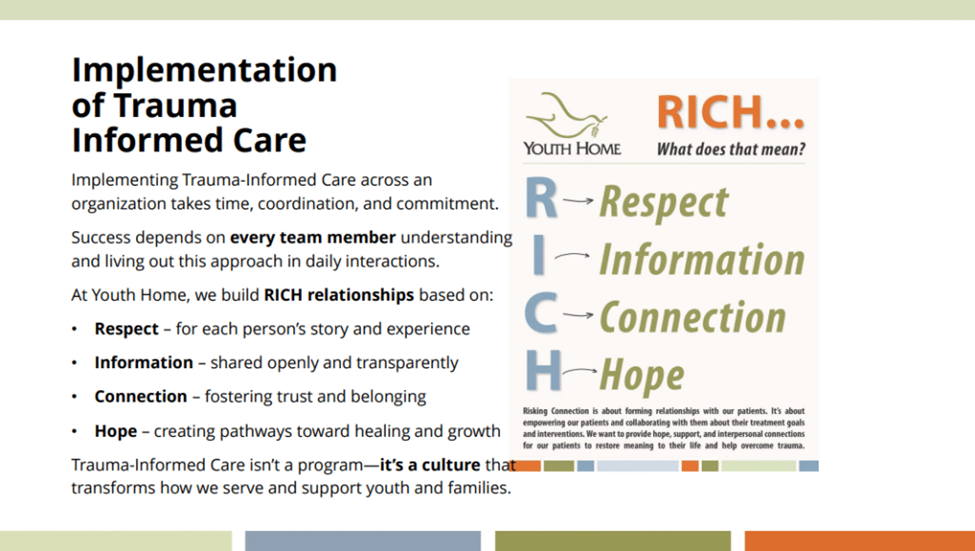
The results of this transition were tangible. Ms. Kelly reported operational and clinical improvements at Youth Home, including lower restraint and seclusion rates, fewer injuries, fewer workers’ compensation claims, and stabilized staff turnover.
Ms. Kelly shared a few actionable insights for executives who want to embed TIC principles across the organization. Her advice: start with staff safety, make trauma-informed leadership non-negotiable, and sustain cultural momentum through coaching and language.
A common mistake many organizations make before TIC implementation is to treat staff burnout or “compassion fatigue” as an individual failure that is best treated through self-care, work/life boundaries, and time off—or corrected through punitive, authoritarian structures. Instead, leaders must integrate staff treatment in the process, focusing on emotional regulation, psychological safety, and relational accountability in every interaction.
“We teach our folks emotional regulation skills,” said Ms. Kelly. “Those are the kind of skills they must develop to become a good clinician, and it also is a protective factor from becoming fatigued and stressed by the work. Your staff has really got to be the first part of your implementation. When staff feel emotionally safe, they can bring their best selves to work.”
But the transition to trauma-informed models is not solely a “staff” issue—leadership must fully commit to TIC. This includes establishing clear cultural expectations that allow the TIC principles to take root and successfully govern all operational decisions. Ms. Kelly noted that any gap between stated values and executive behavior will undermine the culture change. “It requires buy-in from the very top…The number one thing leaders must do is to spend an awful lot of time helping staff understand their stress. That means understanding where it comes from and how to properly manage it.”
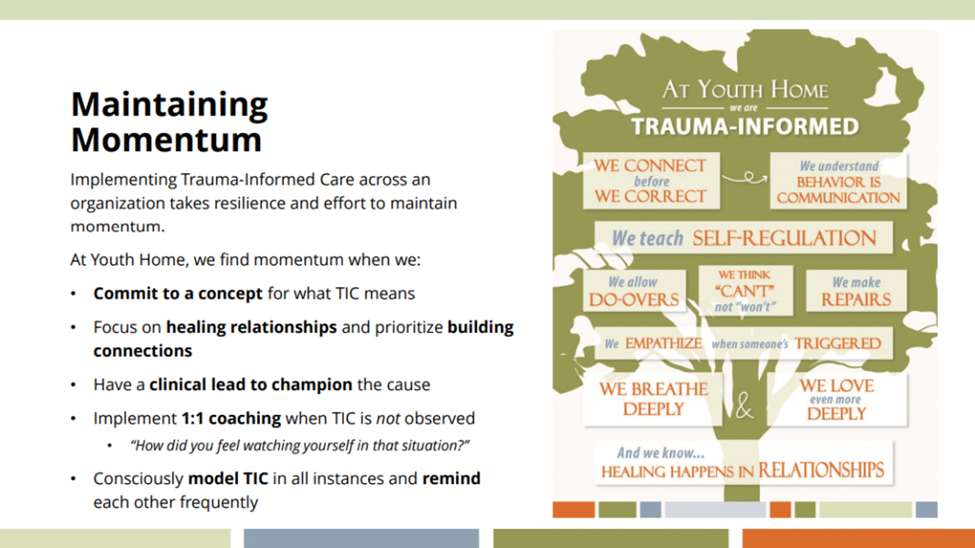
Finally, Ms. Kelly emphasized that it is important to build ongoing support of the culture of TIC. She said that the transformation does not have a “plateau” where it remains in place, unchanged, after adoption. Ensuring that trauma-informed culture becomes stronger means actively supporting it. Some of the Youth Home’s initiatives to support the culture include appointing a cultural champion, constantly training all staff in the shared TIC model, integrating TIC language into all documentation and communication, and reinforcing expectations through coaching.
“Once you pick a TIC model, the most important thing is to look out for slippage,” said Ms. Kelly. “Are you going to slide back into the old behavior? How are you going to sustain this over the long haul? Our executive team was trained first, our clinical team second, and then we made the choice to train every single individual in our agency, from the front office to the maintenance staff to the kitchen team.”
The final takeaway for executives is to recognize TIC is more than a clinical initiative—it is a leadership initiative. Or as Ms. Kelly noted, “If I could say only one thing about this, it’s to train everyone in your facility about how trauma affects brain development and how punitive measures don’t work. You must learn a new way. I made it clear up front that we are going forward with this. We’re not going back.”