
By Monica E. Oss, Chief Executive Officer, OPEN MINDS
If you want to see the future of the health and human service market, don’t look to Washington—watch the states. The past 11 months of changes in policies and budgets brought by the Trump administration has pushed many policy decisions and budget responsibility to the states.
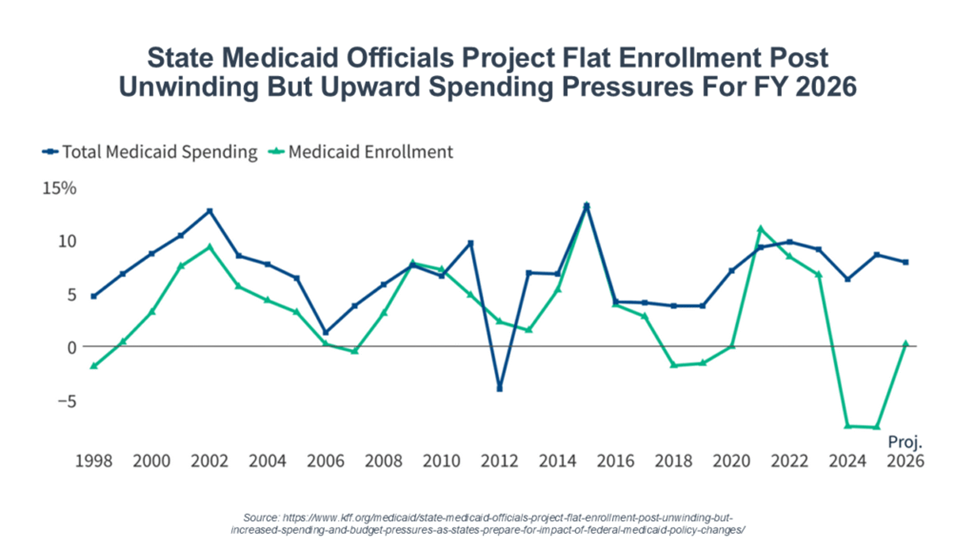
So what do state-level thought leaders think is coming? Their prediction is that Medicaid enrollment will remain flat in FY 2026—while Medicaid spending is expected to grow 7.9%. These were the results of a survey of state Medicaid executives published in A View Of Medicaid Today And A Look Ahead: Balancing Access, Budgets And Upcoming Changes.
These changes in enrollment and spend follow a tumultuous FY 2025—with Medicaid enrollment falling 7.6% and spending increasing by 8.6% in the same period. State executives cite provider rate increases; greater enrollee health care needs; and increasing costs for long-term care, pharmacy benefits, and behavioral health services as the most significant drivers of these cost increases.
Almost two-thirds of state executives think there is a “50-50” chance of a Medicaid budget shortfall in their state next year. This is happening at a time when the recent Congressional budget bill does not permit increased provider taxes. As a result, the executives are predicting fewer provider organization rate increases and an uptick in rate restrictions.
We recently gathered to hear experts from three states—Illinois, Kansas, and Pennsylvania—discuss the emerging pressures on governors and legislatures in the session Shaping A Chaotic Market At The State Level: A State Association Executive Discussion at The 2025 OPEN MINDS Technology & Analytics Institute. These state association leaders shared insights on how to affect state policy and what they see as the critical issues for state advocacy in the year ahead.
The discussion had three themes. First, while federal policy is setting the stage, the hard choices are landing in state capitals. Second, these shifts are causing new operating realities for provider organization executives. And finally, to have an impact in the current environment, health and human service advocacy at the state level requires a new approach—with coalition-based advocacy, disciplined data storytelling, and relentless presence “at the table.”
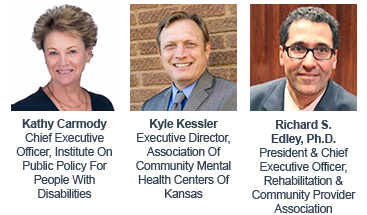
Kyle Kessler, the executive director of the Association of Community Mental Health Centers of Kansas (ACMHCK) emphasized that statehouses—not Washington—have become the fulcrum for decisions that determine coverage, rates, and access. ACMHCK, representing the state’s 26 community mental health centers, leads legislative advocacy, education, and system coordination to strengthen community mental health services statewide.
He noted, “Over a decade, we’ve seen our state government in Kansas—and a lot of states around the Midwest—really grab a lot of the power or a lot of the policymaking direction from the federal government.” He described how it is state-level initiatives that are pushing a wide range of reforms like Certified Community Behavioral Health Clinic adoption and workforce development initiatives.
Kathy Carmody, the chief executive officer of the Institute on Public Policy for People with Disabilities (IPPPD), built on Mr. Kessler’s observations, noting “there are some very sobering conversations within state agencies and within state legislatures they have not had to have in the past,” as Medicaid revenue softens and agencies set aside reserves. IPPPD is an Illinois intellectual and developmental disabilities (I/DD) policy and advocacy organization that convenes stakeholders, and advances initiatives on rates, workforce, and access across Illinois. Ms. Carmody noted that in her work, rules, waiver details, and budget mechanics are moving faster at the state level. This is happening in an environment where partisanship process volatility creates snap decisions, late-session surprises, and a higher risk that consumers with complex needs fall through the cracks.
The state association executives were candid about how the current environment has changed their approach to representing provider organizations serving consumers with complex needs. Richard S. Edley, Ph.D., president and chief executive officer of Pennsylvania-based Rehabilitation & Community Providers Association (RCPA), discussed how, instead of reacting to lawmakers’ decisions, RCPA has shifted from pure policy expertise to registered, on-the-floor lobbying—“fighting the fight … to the point where legislators and the administration can’t ignore us.” RCPA, representing provider organizations serving consumers with mental health, substance use disorder, I/DD, medical rehabilitation, and brain injury needs, is packaging quick-hitting one-page visuals on vacancies, turnover, waitlists, and budget risks in every meeting with lawmakers.
All three executives discussed how they also have countered the turbulence with disciplined, year-round advocacy built on coalitions, evidence, and presence. Ms. Carmody emphasized a coalition strategy anchored in comparative cost and outcomes—using “By The Numbers” system profiles and concrete contrasts (e.g., state institutions vs. home- and community-based services) to steer choices toward value. And using real-world stories connected to the metrics humanizes the impact of the decisions to be made.
And in the outreach process, Mr. Kessler said that ACMHK team is “priming the room before meetings—public-opinion polling, a 20-city town-hall circuit, and local stories—so policymakers know what your association thinks before you ever arrive.”
These advocacy experts encouraged provider organization executives to up their investment in advocacy—to “treat state strategy as a standing C-suite discipline.” This means identifying the issues at the state level that have the most effect on their organization and its consumers—and come prepared with one-page briefing documents featuring outcomes and impact data for every meeting.
At this particular pivot point in policy and practice in health and human services, this new approach to advocacy is essential. To quote Pulitzer Prize-winning author Nicholas Kristof, “One of the most crucial kinds of intervention is in advocacy. We can think about charities in the context of delivering services, and indeed that is part of their job, but advocacy is also getting governments to step up to the plate. They can also give more voice to those who don’t have one.”