
By Monica E. Oss, Chief Executive Officer, OPEN MINDS
Health and human service policymaker, payer, and provider organization executives are counting on home-based services to solve many of the access, performance, and cost issues in the field. This includes the ability to leverage clinician time with technology, increase speed to services, and the ability to serve consumers in their homes rather than more expensive settings. But this assumption—and those results—depends on consumers having both stable housing and access to technology.
The challenges with access to technology for the 65+ population were the focus of a new analysis—Aging Connected 2025 Report. At the macro level, 32% of people 65+ have no high-speed home internet service. And 27% of this population doesn’t have desktop or laptop computers.
In addition, the access to technology in the 65+ population isn’t evenly distributed. Seventy nine percent of this population in metro areas have broadband wireline service at home compared with 67% in non-metro areas. (For cellular data plans, those statistics are 88% and 80%, respectively.)
Income is also a factor. Only 48% of the lowest income older adults (aged 65+ with annual household incomes below $25,000) have broadband, and 58% have cellular data plans.
And for older adults with less than a high school education, 53% have broadband. This is 59% for older adults who are Black, 64% for Hispanics.
This issue in technology access for the 65+ population will be a growing factor in health and human service delivery and costs in the years ahead. We got a deep dive into new approaches for using technology to address the needs of the 65+ population in the session, Ensuring Engagement & Improving Access For Seniors Through The Latest Tech & AI, during The 2025 OPEN MINDS Aging In Place Summit. The speakers, Heather Adler, vice president, payer partnerships, Talkspace, Cole Samaroo, chief executive officer, Senior Tech Connect (STC), and Melisa Hinojosa, principal patient experience for CenterWell Senior Primary Care (CenterWell), presented two compelling case studies of how technology can be deployed to improve services for this population.
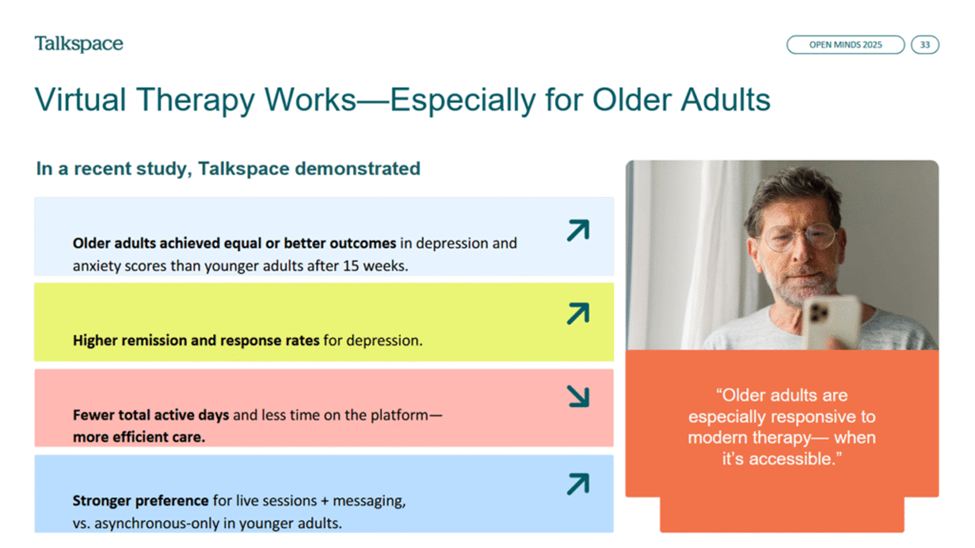
Talkspace is a leading national virtual behavioral health provider organization. With $230 million in annual revenue, the company employs over 500 people and offers therapy for individuals, teens and couples, psychiatric treatment and medication management, and artificial intelligence (AI)‑assisted chat and video counseling through a HIPAA‑compliant mobile platform.
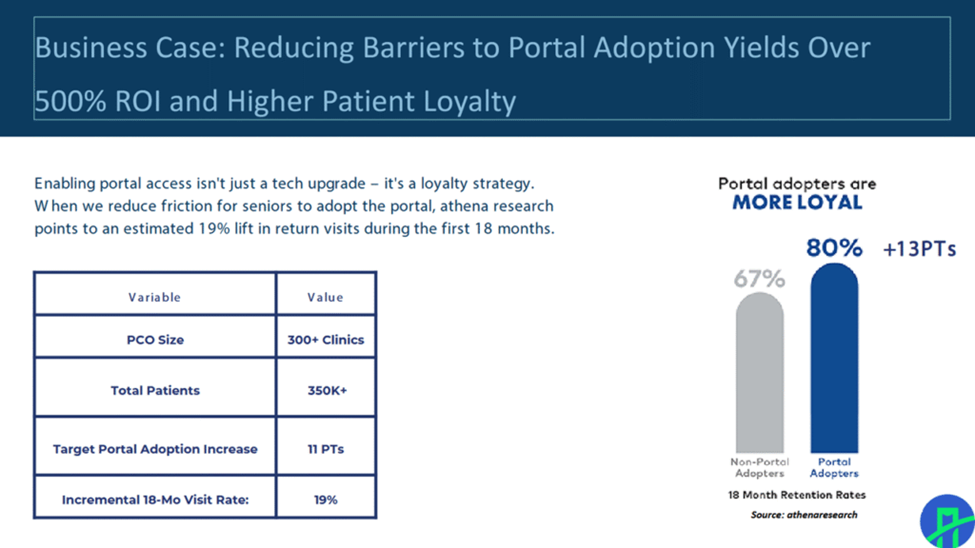
CenterWell, a division of Humana, operates a large network of more than 300 clinics serving over 350,000 Medicare and Medicare Advantage members. The organization has over $466 million in annual revenue and 950 employees. STC offers personalized digital-skills training for older adults and is working with CenterWell.

Talkspace is investing heavily in digital technologies to deliver virtual behavioral health services to the Medicare population. Ms. Alder explained that Talkspace saw an increase in anxiety and depression among older adults between 2018 and 2020 by a factor of 2.5—and recognized that 61% of people aged 65 and older now own smartphones.
To meet these seniors where they are, Talkspace is now offering AI‑assisted chat and video counseling through a HIPAA‑compliant mobile platform and is pursuing Medicare credentialing, state‑by‑state rollouts and product modifications—such as eliminating asynchronous messaging for Medicare members—to ensure ease of use. Ms. Alder said the expansion into Medicare is about more than compliance; it is designed to “simplify onboarding, conduct focus groups, and partner with payers to ensure equitable access.”
The outcomes of these investments are starting to emerge. Talkspace’s AI text‑coach can answer routine questions and triage concerns so licensed clinicians can focus on higher‑level care. Customizing the platform and credentialing more therapists will expand access for older adults.
CenterWell has also invested in expanding access for Medicare and Medicare Advantage members through an expansion of its EHR functionality. Part of the driver, as Ms. Hinojosa noted, was that although 36% of seniors believe a primary‑care clinician is the most important factor in aging well, 50% do not have regular visits.
To leverage their EHR for consumer access, CenterWell added key member-facing functionality—access to prescriptions, referrals, and lab results; a library of digital literacy videos; a series of health management webinars; and AI-enabled text/call support for members. In addition, they added local “digital ambassadors” to provide one‑on‑one assistance. Much of this member support was in partnership with STC, whose team is providing the personalized digital skills training through group classes and one‑on‑one coaching.
Mr. Samaroo noted that seniors frequently struggle with multifactor authentication, cross‑device email access, and QR codes—“only 5% can scan codes unassisted”. And many in the 65+ population tell him that “the tech world is developing without them,” leaving them feeling excluded and disconnected from essential health services. He cautioned that as more services are delivered digitally, these barriers can widen health disparities and reduce engagement.
The early results of this expansion of consumer-facing functionality are promising. CenterWell data shows 85% of members who viewed the how to digital videos attempted the tasks and nearly half watched the videos more than once. There was also an 11% increase in portal adoption and a 19% increase in 18‑month visit rates. And in terms of member retention, their initial data shows that member using the portal and digital tools are 13% more likely to stay with a Humana health plan. Their initial estimates of return on investment in these technology enhancements is 500%.
The presenters closed the session by sharing advice and lessons learned. They encouraged executives to measure digital literacy and embed digital assistance into clinical workflows through “digital ambassadors,” and leverage AI to extend clinical capacity without sacrificing human connection.
One key theme of the session was the need to view the tech-enabled consumer as the ‘new normal’. This means measuring digital literacy and the use of digital services as part of overall measures of member service. And digital elements of service delivery need to be imbedded in standard clinical workflows— supported by ‘digital ambassadors’ to provide just-in-time assistance.
Another consideration for executive teams is to determine how best to use AI in service delivery and support. Both Talkspace and CenterWell are using AI-enabled tools to enhance member experience through streamlined processes and support of service delivery.
The lessons in this session are clear—serving the 65+ population will require strategic investments in digital literacy and culturally competent tools. As the 65+ population in the U.S. grows—and evolves—addressing their tech preferences will be a critical element in strategy.