
By Monica E. Oss, Chief Executive Officer, OPEN MINDS
States continue to be challenged with serving their citizens with I/DD. The most recent data—State Of The States In Intellectual And Developmental Disabilities—shows total public spending grew 7% from 2021 to 2023. Eighty-three percent of this spending comes from Medicaid and 87% of those beneficiaries live in community settings with six or fewer people.
To address the increasing demand for services and related costs, states are taking different policy directions. The California Department of Health Care Services is developing a state plan amendment to move its ICF housing settings from waiver coverage to a state plan benefit. Vermont is building individual budgets for consumers. New York is promoting assistive technology and remote supports.
Other states are moving ahead with new managed care initiatives that include people with I/DD. Virginia has its Cardinal Care Managed Care Program, launched on July 1, 2025, that includes home and community-based long-term services and supports. A year ago, the Florida Medicaid program launched a pilot program in two regions to move services for consumers with I/DD under waivers to managed care.
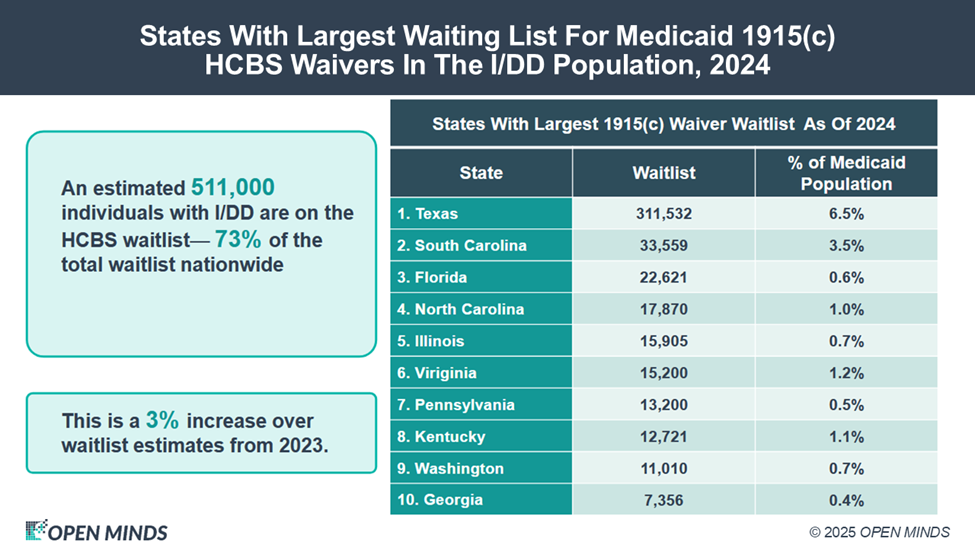
At the same time, states are trying to reduce the number of consumers with I/DD on the waiting list for HCBS services. Pennsylvania reduced its HCBS waitlist for individuals with I/DD by 19% with an increased budget. And in June of this year, Nebraska eliminated its waiting list for HCBS services.
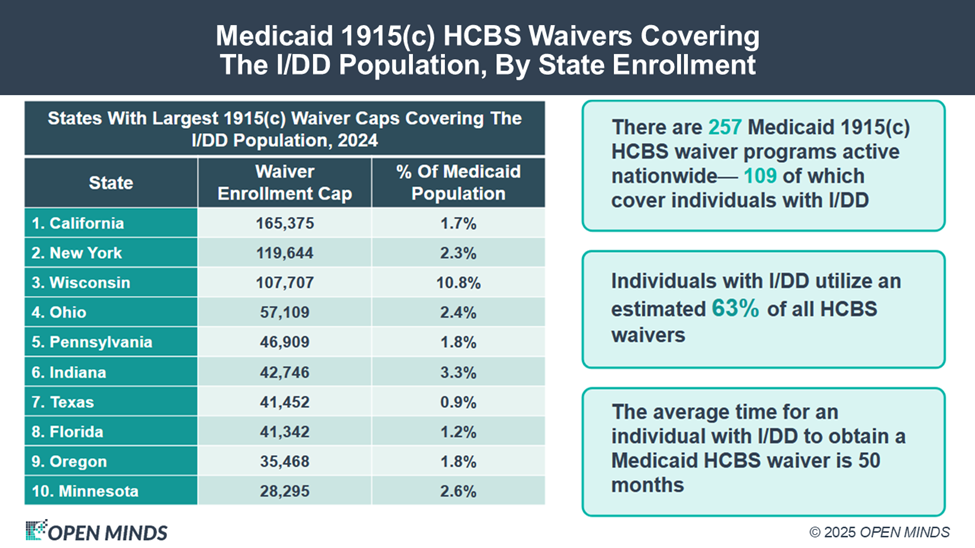
Our market intelligence team recently took a look at the Medicaid HCBS waivers covering consumers with I/DD—summarized in our new report—Medicaid Home & Community-Based Services Waivers Covering The I/DD Population: An OPEN MINDS Market Intelligence Report. There are 257 Medicaid 1915(c) HCBS waiver programs active nationwide—109 of which cover individuals with I/DD. Our analysis found that 46 states (and D.C.) have these waivers for the I/DD population. The exceptions are Arizona, New Jersey, Rhode Island, and Vermont.
Individuals with I/DD utilize an estimated 63% of all HCBS waiver slots. The states with the highest number of Medicaid 1915(c) HCBS waiver slots for consumers with I/DD are California, New York, and Wisconsin.
It takes an average of 50 months for consumers with I/DD to access the services of Medicaid HCBS waiver program. The number of consumers with I/DD on the resulting waiting lists are greatest in Texas, South Carolina, and Florida, while the states with largest recent increases in these waiting lists are Pennsylvania, New Mexico, and Minnesota.
State-by-state information about Medicaid 1915(c) HCBS waivers covering individuals with I/DD can be found in the new report—Medicaid Home & Community-Based Services Waivers Covering The I/DD Population: An OPEN MINDS Market Intelligence Report. The report provides a description of each state waiver, along with enrollment caps of each.